Unpositioned
Edit position
Edit position

No position recorded yet. Picking a shelf here sets the manual override.

The national picture : the art of Tasmania's Black War / Tim Bonyhady and Greg Lehman
Diagnose this book
Open in Vernon Browser

The national picture : the art of Tasmania's Black War / Tim Bonyhady and Greg Lehman

by Tim Bonyhady, Greg Lehman

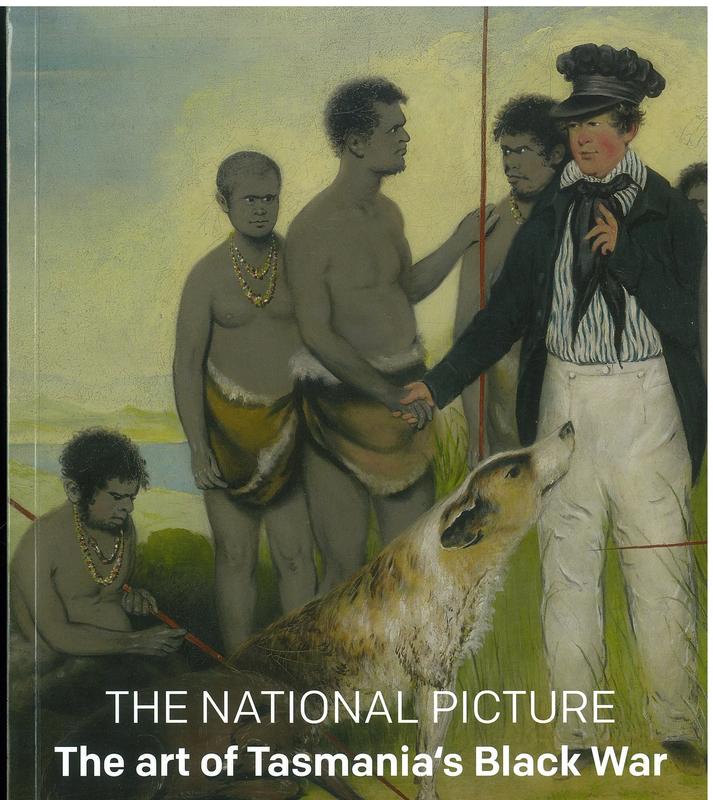
This study examines Benjamin Duterrau's visual records of Tasmanian Aboriginal people and George Augustus Robinson's conciliation mission. It also analyses the use of art as a means of communication by Surveyor-General George Frankland during the colonial period.

Accession 13849 ISBN 9780642334763 Publisher
Book Images
Reference and live side by side Hover to see live images

Reference
The national picture : the art of Tasmania's Black War / Tim Bonyhady and Greg Lehman spine
The national picture : the art of Tasmania's Black War / Tim Bonyhady and Greg Lehman cover
Live
No live
No live
The national picture : the art of Tasmania's Black War / Tim Bonyhady and Greg Lehman spine
No live
The national picture : the art of Tasmania's Black War / Tim Bonyhady and Greg Lehman cover
No live
TAGS
Curated Derived
Art History Painting Publications Writing
CONNECTIONS
No connections
State
on_shelf
True
position_updated_at
never
orientation
unknown
Details

Physical

binding_type
Hard Back
dimensions
none captured
spine_text
none captured
LOCATION HISTORY
No location history available for this book.
Vernon snapshot
View live

Frozen copy of Vernon's record from the last sync. Fields tagged flow back into the Pulse record.

Last synced 2026-05-21 10:00 (4 days, 3 hours ago)

Identity

name→ title
The national picture : the art of Tasmania's Black War / Tim Bonyhady and Greg Lehman
vernon_id
22045
accession_no→ accession_number
13849
vernon_slug
the-national-picture-the-art-of-tasmanias-black-war-tim-bonyhady-and-greg-lehman

Drives Pulse state

curr_loc_status→ on_shelf
On Shelf
location_name
Zone N4/Level 2 (Mezzanine)/Phrontisterion/MONA
location_reason
On Shelf
isbn_issn→ isbn (when valid)
9780642334763

Descriptive

production_date
2018
object_type
Books/Document genres/Information forms/Visual and Verbal Communication, Exhibition catalogues/Catalogues/Document genres/Information forms/Visual and Verbal Communication
object_status
Accessioned
brief_description
Benjamin Duterrau and his National picture project are at the core of this publication because he was the colonial artist most interested in Tasmania's Aboriginal people, and the only artist who chose to depict, on a substantial scale, their conciliation or pacification by George Augustus Robinson. While Duterrau's weaknesses as an artist are obvious, his limited skill largely saved him from bombast - a recurrent problem with history painting of his era. Despite the disappearance of much of his work, Duterrau also left us with a rich array of often striking images of individuals and subjects of great enduring significance, where there otherwise would be none. They provide us with a vital means of conjuring the past. For Tasmanian Aboriginal people today, Duterrau's paintings provide a tantalising and rare visual record of the unique culture practice of their ancestors. Robinson's journals offer written descriptions of activities, such as spear-making and throwing, kangaroo hunting and ceremonial dance, accompanied by only a scattering of small, often crude sketches, which are vitally important firsthand observations. But it was Duterrau, alone among colonial artists in Van Diemen's Land, who painted these scenes on a large scale. His anatomical modelling may be poor, but Duterrau's paintings have a sense of life that is not found elsewhere, and reflect his well-documented sympathy for Aboriginal people at the hands of a violent invading force. This publication is also framed around an image conceived by Tasmania's Surveyor-General George Frankland almost three years before Duterrau arrived in Hobart. The catalyst was Frankland's discovery that Aboriginal culture included a visual language. On a visit to the island's far north-west, he encountered drawings on trees and inside huts that included depictions of colonists. Words having manifestly failed because of the settlers' ignorance of Aboriginal languages, Frankland thought art could provide a novel means of communication and created a series of drawings that he described as depicting 'the cause of the present warfare' and the 'real wishes of the government' towards Aboriginal people: 'the desired termination of hostility'. His plan was that these drawings be reproduced and distributed around the bush, fastened on trees, where Aboriginal people were most likely to see them. He was so excited by this idea that, in February 1829, he wrote about it twice in the course of a week - to the colony's Lieutenant-Governor George Arthur, and to a member of the Colonial Office in London, advocating this use of pictures as an experiment worth trying since 'everything ought to be tried to accomplish a reconciliation'.

Subjects & people

authors→ author (initial fill only)
Tim Bonyhady, Greg Lehman
tags→ tags
Art, Arts, Graphic arts, Exhibition catalogues, Catalogues, Painting -- Australian, Tasmania -- History -- Black War, 1825-1831
subject_people
George Augustus Robinson (English, b.1791, d.1866)
subject_objects

Cover image

vernon_cover_image_id→ cover_image
22070

Raw Vernon JSON

click to inspect

The source payload behind the snapshot above.

Use ⌘F to search once expanded.
{7 keys}
"slug": "the-national-picture-the-art-of-tasmanias-black-war-tim-bonyhady-and-greg-lehman"
"opacObjectId": "22045"
"opacCollection": {1 keys}
"opacCollectionId": "1"
"imagesCollection": {2 keys}
"images": [1 items]
"[0]": {5 keys}
"imageId": "22070"
"cssColors": [4 items]
"[0]": {9 keys}
"hex": "696969"
"hue": 0
"rank": 1
"presence": 72.28
"colorName": "dimgray"
"lightness": 41
"colorGroup": "gray"
"saturation": 0
"formattedColorName": "dim gray"
"[1]": {9 keys}
"hex": "000000"
"hue": 0
"rank": 2
"presence": 14.39
"colorName": "black"
"lightness": 0
"colorGroup": "gray"
"saturation": 0
"formattedColorName": "black"
"[2]": {9 keys}
"hex": "f5f5dc"
"hue": 60
"rank": 3
"presence": 3.54
"colorName": "beige"
"lightness": 91
"colorGroup": "white"
"saturation": 56
"formattedColorName": "beige"
"[3]": {9 keys}
"hex": "bdb76b"
"hue": 56
"rank": 4
"presence": 1.49
"colorName": "darkkhaki"
"lightness": 58
"colorGroup": "yellow"
"saturation": 38
"formattedColorName": "dark khaki"
"rawColors": [7 items]
"[0]": {6 keys}
"hex": "797b5a"
"hue": 63
"rank": 1
"presence": 72.28
"lightness": 41
"saturation": 15
"[1]": {6 keys}
"hex": "232921"
"hue": 105
"rank": 2
"presence": 14.39
"lightness": 14
"saturation": 10
"[2]": {6 keys}
"hex": "edeedf"
"hue": 64
"rank": 3
"presence": 3.54
"lightness": 90
"saturation": 30
"[3]": {6 keys}
"hex": "b3b480"
"hue": 61
"rank": 4
"presence": 1.49
"lightness": 60
"saturation": 25
"[4]": {6 keys}
"hex": "4e511f"
"hue": 63
"rank": 5
"presence": 5.71
"lightness": 21
"saturation": 44
"[5]": {6 keys}
"hex": "353325"
"hue": 52
"rank": 6
"presence": 2.53
"lightness": 17
"saturation": 17
"[6]": {6 keys}
"hex": "a7aba5"
"hue": 100
"rank": 7
"presence": 0.07
"lightness": 65
"saturation": 3
"imageLabels": [10 items]
"[0]": {5 keys}
"count": 271
"score": 92.38
"status": "auto_verified"
"imageLabel": "Vertebrate"
"imageLabelId": 428
"[1]": {5 keys}
"count": 278
"score": 89.34
"status": "auto_verified"
"imageLabel": "Human"
"imageLabelId": 214
"[2]": {5 keys}
"count": 11006
"score": 79.31
"status": "auto_verified"
"imageLabel": "Art"
"imageLabelId": 4
"[3]": {5 keys}
"count": 1442
"score": 79.31
"status": "auto_verified"
"imageLabel": "Adaptation"
"imageLabelId": 43
"[4]": {5 keys}
"count": 450
"score": 79.16
"status": "auto_verified"
"imageLabel": "Hat"
"imageLabelId": 348
"[5]": {5 keys}
"count": 913
"score": 74.34
"status": "auto_verified"
"imageLabel": "Happy"
"imageLabelId": 66
"[6]": {5 keys}
"count": 935
"score": 70.49
"status": "auto_verified"
"imageLabel": "Vintage clothing"
"imageLabelId": 81
"[7]": {5 keys}
"count": 829
"score": 67.7
"status": "auto_verified"
"imageLabel": "Grass"
"imageLabelId": 119
"[8]": {5 keys}
"count": 495
"score": 67.5
"status": "auto_verified"
"imageLabel": "Working animal"
"imageLabelId": 247
"[9]": {5 keys}
"count": 2395
"score": 66.81
"status": "auto_verified"
"imageLabel": "Event"
"imageLabelId": 46
"imageDerivatives": [6 items]
"[0]": {4 keys}
"url": "https://browser.mona.net.au/records/images/large/7997/f240eca036f7f857abb1afb956601665c4063be8.jpg"
"width": "713"
"height": "800"
"identifier": "LARGE"
"[1]": {4 keys}
"url": "https://browser.mona.net.au/records/images/medium/7997/f240eca036f7f857abb1afb956601665c4063be8.jpg"
"width": "356"
"height": "400"
"identifier": "MEDIUM"
"[2]": {4 keys}
"url": "https://browser.mona.net.au/records/images/nano/7997/f240eca036f7f857abb1afb956601665c4063be8.jpg"
"width": "31"
"height": "35"
"identifier": "NANO"
"[3]": {4 keys}
"url": "https://browser.mona.net.au/records/images/small/7997/f240eca036f7f857abb1afb956601665c4063be8.jpg"
"width": "134"
"height": "150"
"identifier": "SMALL"
"[4]": {4 keys}
"url": "https://browser.mona.net.au/records/images/tiny/7997/f240eca036f7f857abb1afb956601665c4063be8.jpg"
"width": "67"
"height": "75"
"identifier": "TINY"
"[5]": {4 keys}
"url": "https://browser.mona.net.au/records/images/xlarge/7997/f240eca036f7f857abb1afb956601665c4063be8.jpg"
"width": "1069"
"height": "1200"
"identifier": "XLARGE"
"totalImages": 1
"objectSearchScore": 5.9544444
"opacObjectFieldSets": [40 items]
"[0]": {2 keys}
"identifier": "accession_no"
"opacObjectFields": [1 items]
"[0]": {1 keys}
"value": "13849"
"[1]": {2 keys}
"identifier": "name"
"opacObjectFields": [1 items]
"[0]": {2 keys}
"value": "The national picture : the art of Tasmania's Black War / Tim Bonyhady and Greg Lehman"
"opacObjectFieldAttributes": [1 items]
"[0]": {2 keys}
"key": "title"
"value": "The national picture : the art of Tasmania's Black War / Tim Bonyhady and Greg Lehman"
"[2]": {2 keys}
"identifier": "other_name"
"opacObjectFields": [1 items]
"[0]": {1 keys}
"value": ""
"[3]": {2 keys}
"identifier": "artist_last_first"
"opacObjectFields": [2 items]
"[0]": {1 keys}
"value": "Bonyhady, Tim"
"[1]": {1 keys}
"value": "Lehman, Greg"
"[4]": {2 keys}
"identifier": "prod_pri_date"
"opacObjectFields": [1 items]
"[0]": {2 keys}
"value": "2018"
"opacObjectFieldAttributes": [2 items]
"[0]": {2 keys}
"key": "earliest_date"
"value": "2018-01-01Z"
"[1]": {2 keys}
"key": "latest_date"
"value": "2018-12-31Z"
"[5]": {2 keys}
"identifier": "prod_pri_date_notes"
"opacObjectFields": [1 items]
"[0]": {1 keys}
"value": ""
"[6]": {2 keys}
"identifier": "edition"
"opacObjectFields": [1 items]
"[0]": {1 keys}
"value": ""
"[7]": {2 keys}
"identifier": "brief_desc"
"opacObjectFields": [1 items]
"[0]": {1 keys}
"value": "Benjamin Duterrau and his National picture project are at the core of this publication because he was the colonial artist most interested in Tasmania's Aboriginal people, and the only artist who chose to depict, on a substantial scale, their conciliation or pacification by George Augustus Robinson. While Duterrau's weaknesses as an artist are obvious, his limited skill largely saved him from bombast - a recurrent problem with history painting of his era. Despite the disappearance of much of his work, Duterrau also left us with a rich array of often striking images of individuals and subjects of great enduring significance, where there otherwise would be none. They provide us with a vital means of conjuring the past. For Tasmanian Aboriginal people today, Duterrau's paintings provide a tantalising and rare visual record of the unique culture practice of their ancestors. Robinson's journals offer written descriptions of activities, such as spear-making and throwing, kangaroo hunting and ceremonial dance, accompanied by only a scattering of small, often crude sketches, which are vitally important firsthand observations. But it was Duterrau, alone among colonial artists in Van Diemen's Land, who painted these scenes on a large scale. His anatomical modelling may be poor, but Duterrau's paintings have a sense of life that is not found elsewhere, and reflect his well-documented sympathy for Aboriginal people at the hands of a violent invading force. This publication is also framed around an image conceived by Tasmania's Surveyor-General George Frankland almost three years before Duterrau arrived in Hobart. The catalyst was Frankland's discovery that Aboriginal culture included a visual language. On a visit to the island's far north-west, he encountered drawings on trees and inside huts that included depictions of colonists. Words having manifestly failed because of the settlers' ignorance of Aboriginal languages, Frankland thought art could provide a novel means of communication and created a series of drawings that he described as depicting 'the cause of the present warfare' and the 'real wishes of the government' towards Aboriginal people: 'the desired termination of hostility'. His plan was that these drawings be reproduced and distributed around the bush, fastened on trees, where Aboriginal people were most likely to see them. He was so excited by this idea that, in February 1829, he wrote about it twice in the course of a week - to the colony's Lieutenant-Governor George Arthur, and to a member of the Colonial Office in London, advocating this use of pictures as an experiment worth trying since 'everything ought to be tried to accomplish a reconciliation'."
"[8]": {2 keys}
"identifier": "measure_desc"
"opacObjectFields": [1 items]
"[0]": {1 keys}
"value": ""
"[9]": {2 keys}
"identifier": "credit_line"
"opacObjectFields": [1 items]
"[0]": {1 keys}
"value": ""
"[10]": {2 keys}
"identifier": "curr_loc_status"
"opacObjectFields": [1 items]
"[0]": {2 keys}
"value": "On Shelf"
"opacObjectFieldAttributes": [1 items]
"[0]": {2 keys}
"key": "search"
"value": "curr_loc_status:"On Shelf""
"[11]": {2 keys}
"identifier": "ob_status"
"opacObjectFields": [1 items]
"[0]": {1 keys}
"value": "Accessioned"
"[12]": {2 keys}
"identifier": "lender"
"opacObjectFields": [1 items]
"[0]": {1 keys}
"value": ""
"[13]": {2 keys}
"identifier": "copyright_owner"
"opacObjectFields": [1 items]
"[0]": {1 keys}
"value": ""
"[14]": {2 keys}
"identifier": "copyright_type"
"opacObjectFields": [1 items]
"[0]": {1 keys}
"value": ""
"[15]": {2 keys}
"identifier": "copyright_start"
"opacObjectFields": [0 items]
"[16]": {2 keys}
"identifier": "copyright_expiry"
"opacObjectFields": [0 items]
"[17]": {2 keys}
"identifier": "copyright_notes"
"opacObjectFields": [1 items]
"[0]": {1 keys}
"value": ""
"[18]": {2 keys}
"identifier": "curr_loc"
"opacObjectFields": [1 items]
"[0]": {1 keys}
"value": "Zone N4/Level 2 (Mezzanine)/Phrontisterion/MONA"
"[19]": {2 keys}
"identifier": "object_type"
"opacObjectFields": [2 items]
"[0]": {2 keys}
"value": "Books/Document genres/Information forms/Visual and Verbal Communication"
"opacObjectFieldAttributes": [1 items]
"[0]": {2 keys}
"key": "search"
"value": "object_type:"Books/Document genres/Information forms/Visual and Verbal Communication""
"[1]": {2 keys}
"value": "Exhibition catalogues/Catalogues/Document genres/Information forms/Visual and Verbal Communication"
"opacObjectFieldAttributes": [1 items]
"[0]": {2 keys}
"key": "search"
"value": "object_type:"Exhibition catalogues/Catalogues/Document genres/Information forms/Visual and Verbal Communication""
"[20]": {2 keys}
"identifier": "collection"
"opacObjectFields": [1 items]
"[0]": {2 keys}
"value": "Main Collection/Library"
"opacObjectFieldAttributes": [1 items]
"[0]": {2 keys}
"key": "search"
"value": "collection:"Main Collection/Library""
"[21]": {2 keys}
"identifier": "prod_pri_place"
"opacObjectFields": [1 items]
"[0]": {1 keys}
"value": "Canberra/ACT/Australia"
"[22]": {2 keys}
"identifier": "prod_pri_publisher"
"opacObjectFields": [1 items]
"[0]": {1 keys}
"value": "National Gallery of Australia"
"[23]": {2 keys}
"identifier": "physical_notes"
"opacObjectFields": [2 items]
"[0]": {1 keys}
"value": "256 pages : illustrations (colour) ; 27 cm."
"[1]": {1 keys}
"value": "Includes bibliographical references & index."
"[24]": {2 keys}
"identifier": "language"
"opacObjectFields": [1 items]
"[0]": {1 keys}
"value": "English"
"[25]": {2 keys}
"identifier": "isbn_issn"
"opacObjectFields": [1 items]
"[0]": {1 keys}
"value": "9780642334763"
"[26]": {2 keys}
"identifier": "user_sym_1"
"opacObjectFields": [1 items]
"[0]": {1 keys}
"value": "759.994 BON"
"[27]": {2 keys}
"identifier": "usual_loc_being"
"opacObjectFields": [1 items]
"[0]": {1 keys}
"value": "Zone N4/Level 2 (Mezzanine)/Phrontisterion/MONA"
"[28]": {2 keys}
"identifier": "subject_class"
"opacObjectFields": [3 items]
"[0]": {2 keys}
"value": "Tasmania -- History -- Black War, 1825-1831"
"opacObjectFieldAttributes": [1 items]
"[0]": {2 keys}
"key": "search"
"value": "subject_class:"Tasmania -- History -- Black War, 1825-1831""
"[1]": {2 keys}
"value": "Painting -- Australian/Graphic arts/Art/Arts"
"opacObjectFieldAttributes": [1 items]
"[0]": {2 keys}
"key": "search"
"value": "subject_class:"Painting -- Australian/Graphic arts/Art/Arts""
"[2]": {2 keys}
"value": "Exhibition catalogues/Catalogues"
"opacObjectFieldAttributes": [1 items]
"[0]": {2 keys}
"key": "search"
"value": "subject_class:"Exhibition catalogues/Catalogues""
"[29]": {2 keys}
"identifier": "subject_date"
"opacObjectFields": [0 items]
"[30]": {2 keys}
"identifier": "subject_event"
"opacObjectFields": [1 items]
"[0]": {2 keys}
"value": "The National Picture : the Art of Tasmania's Black War; 12 May 2018-29 Jul 2018"
"opacObjectFieldAttributes": [1 items]
"[0]": {2 keys}
"key": "search"
"value": "subject_event:"The National Picture : the Art of Tasmania's Black War; 12 May 2018-29 Jul 2018""
"[31]": {2 keys}
"identifier": "subject_period"
"opacObjectFields": [1 items]
"[0]": {1 keys}
"value": ""
"[32]": {2 keys}
"identifier": "subject_object"
"opacObjectFields": [1 items]
"[0]": {1 keys}
"value": ""
"[33]": {2 keys}
"identifier": "subject_person"
"opacObjectFields": [1 items]
"[0]": {2 keys}
"value": "George Augustus Robinson (English, b.1791, d.1866)"
"opacObjectFieldAttributes": [1 items]
"[0]": {2 keys}
"key": "search"
"value": "subject_person:"George Augustus Robinson (English, b.1791, d.1866)""
"[34]": {2 keys}
"identifier": "subject_place"
"opacObjectFields": [1 items]
"[0]": {1 keys}
"value": ""
"[35]": {2 keys}
"identifier": "assoc_person"
"opacObjectFields": [1 items]
"[0]": {1 keys}
"value": ""
"[36]": {2 keys}
"identifier": "assoc_place"
"opacObjectFields": [1 items]
"[0]": {1 keys}
"value": ""
"[37]": {2 keys}
"identifier": "assoc_event"
"opacObjectFields": [1 items]
"[0]": {1 keys}
"value": ""
"[38]": {2 keys}
"identifier": "assoc_object"
"opacObjectFields": [1 items]
"[0]": {1 keys}
"value": ""
"[39]": {2 keys}
"identifier": "user_sym_9"
"opacObjectFields": [1 items]
"[0]": {1 keys}
"value": ""
"relationshipsCollection": {2 keys}
"relationships": [1 items]
"[0]": {4 keys}
"relatedRecords": [2 items]
"[0]": {3 keys}
"slug": "tim-bonyhady"
"title": "Tim Bonyhady"
"relatedRecordId": "14905"
"[1]": {3 keys}
"slug": "greg-lehman"
"title": "Greg Lehman"
"relatedRecordId": "26815"
"relationshipId": "object_prod_pri_person"
"relatedRecordType": "person"
"totalRelatedRecords": 2
"totalRelationships": 1