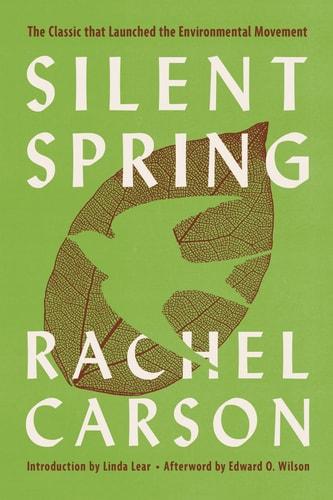
"Silent Spring" by Rachel Carson explores several key themes and topics that can help you draw connections to other books:
* **The Interconnectedness of Life:** A central theme is the intricate balance of nature and how all organisms and their environments are deeply connected. Carson emphasizes that "in nature nothing exists alone" 【6】【8】. This concept can be linked to books discussing ecosystems, biodiversity, or the delicate balance of natural systems.
* **Environmentalism and "Deep Ecology":** The book is a foundational text in modern environmentalism 【7】. It highlights an awareness of life as a complex system, often referred to as "deep ecology," where organisms and their environment are in a fluid but carefully balanced relationship 【2】. Connections can be made to books that advocate for environmental protection, conservation, or explore ecological philosophies.
* **The Precautionary Principle:** Although the term wasn't in use when the book was published, "Silent Spring" embodies the spirit of the precautionary principle. This suggests that when risks are unknown due to insufficient research, it's prudent to act cautiously to avoid potentially dangerous effects 【1】. This theme can connect to books dealing with risk assessment, scientific uncertainty, or the ethics of technological advancement.
* **Humanity's Impact on the Environment:** Carson argues that humanity has entered a new era where humans possess the power to alter their environment on an unprecedented scale 【3】. This theme can be linked to books that examine human civilization's impact on the planet, industrialization, or the consequences of technological progress.
* **Public Education and Responsibility:** A primary goal of "Silent Spring" was to educate the public about the dangers of unchecked pesticide use 【4】. This theme connects to books that focus on the importance of scientific literacy, public awareness campaigns, or the role of citizens in addressing societal issues.
* **Past, Present, and Future:** The book frames its message with a sense of nostalgia for an idealized past and an urgent warning about the future 【5】. This can be connected to books that explore historical perspectives on nature, dystopian or utopian visions, or the long-term consequences of present actions.
By considering these themes, you can find connections to books that discuss ecology, conservation, the ethics of science, human impact on the planet, and the importance of public awareness.