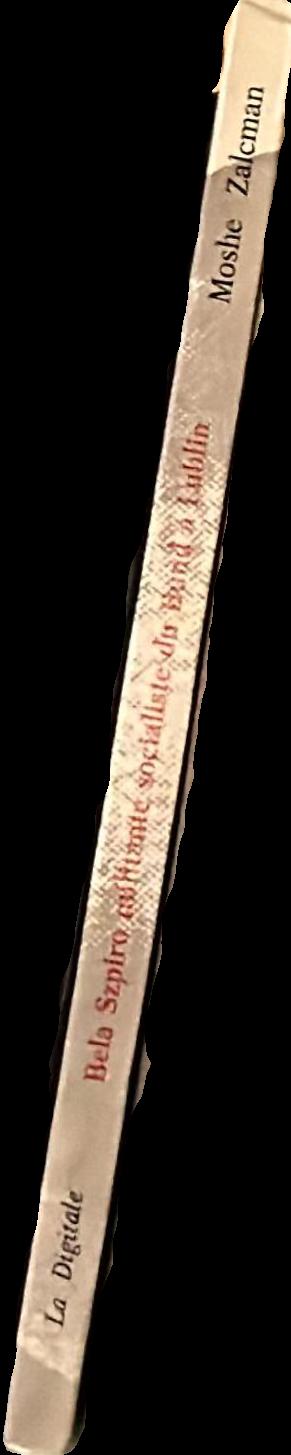
The book "Bela Szpiro: militante socialiste du Bund à Lublin (1890–1944)" by Moshe Zalcman explores several key themes and topics that can help in drawing connections to other books in a library. These include:

*   **Jewish Socialism and the Bund:** The book focuses on Bela Szpiro's involvement with the **General Jewish Labor Bund**, a socialist party active among Jewish people in Eastern Europe. This theme connects to broader works on **socialist movements, Jewish political history, and the history of labor organizations** 【1】【3】.

*   **Jewish Community Life in Lublin:** It details the **evolution of the Jewish community in Lublin** before World War II and its subsequent destruction during the war 【1】【3】. This allows for connections with books on **Polish-Jewish history, urban Jewish life, and the history of specific Eastern European cities** 【7】【8】.

*   **Social Activism and Community Improvement:** Szpiro was dedicated to improving the living conditions of the Jewish community through initiatives like **cooperatives, schools, and libraries** 【1】【4】. This theme links to books on **social reform, community organizing, education, and philanthropy** within Jewish communities.

*   **Women's Role in Jewish Politics and Activism:** As a prominent female activist, Bela Szpiro's story highlights the **contributions of women to Jewish political and social movements** 【2】【5】. This connects to literature on **Jewish women's history, gender roles in political movements, and feminist activism** in historical contexts.

*   **The Holocaust and World War II:** The book covers the period leading up to and including the **disappearance of the Jewish community of Lublin during World War II** 【1】【3】. This allows for connections with broader works on the **Holocaust, World War II in Poland, and the destruction of European Jewry**.

*   **Yiddish Culture and Secular Jewish Education:** Szpiro was also a key figure in the **secular Yiddish school movement** 【6】. This theme connects to books on **Yiddish language and literature, secular Jewish identity, and cultural preservation efforts**.

*   **Biographical Studies:** The book itself is a **biography** 【9】【10】, allowing for connections with other biographies of Jewish activists, socialists, or prominent figures from Eastern Europe. It also touches upon her personal experiences, including **restrictions on education and attitudes towards language** 【2】.