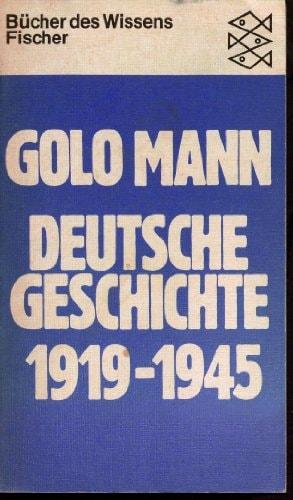
Golo Mann's "Deutsche Geschichte 1919–1945" delves into a pivotal and tumultuous period of German history. The book explores the aftermath of World War I, the establishment and eventual collapse of the **Weimar Republic**, the rise of **Nazism**, and the devastating impact of **World War II** on Germany and the world 【1】【2】.

Key themes and topics within this work include:

*   **The Weimar Republic (1918-1933):** This era is characterized by political instability, economic challenges, and social upheaval following the German Revolution of 1918-1919 【1】【2】.
*   **The Rise of Adolf Hitler and the Nazi Party:** Mann likely examines the factors that contributed to Hitler's ascent to power and the establishment of the Third Reich 【3】.
*   **World War II and its Consequences:** The book would cover Germany's involvement in the war, its devastating impact, and the eventual defeat of Nazi Germany 【8】【10】.
*   **German Identity and Society:** Mann, a noted historian and essayist, likely provides insights into the broader social, cultural, and intellectual developments within Germany during this period 【5】【9】.

Connections to other books could be made through:

*   **Broader German History:** Works covering earlier or later periods of German history, such as "Deutsche Geschichte des 19. und 20. Jahrhunderts" by Golo Mann himself, or general histories of Germany 【4】【11】.
*   **Biographies of Key Figures:** Books focusing on Adolf Hitler, Weimar Republic politicians, or other significant individuals of the era.
*   **Studies of Totalitarianism and Fascism:** Works that analyze the rise and nature of totalitarian regimes in the 20th century.
*   **The Impact of World Wars:** Books detailing the causes, events, and consequences of World War I and World War II.
*   **Intellectual and Cultural History:** Works that explore the intellectual currents and cultural landscape of Germany during this period, potentially including the writings of Golo Mann's father, Thomas Mann 【6】【7】.