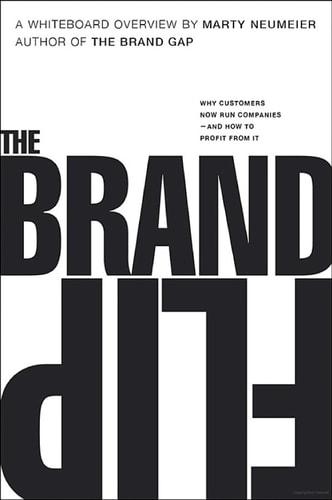
1. **The Power Shift from Companies to Consumers**
The book's central argument is that the traditional model of companies controlling their brands is over. Customers, armed with digital tools and social platforms, now decide what a brand truly means — companies can no longer craft an identity in isolation and expect consumers to accept it unquestioned.

The core inversion here is radical: the brand isn't what the company says it is, it's what customers say it is. Authority flows upward from the customer, not downward from the boardroom.

Connect to books about: consumer behavior, digital empowerment, platform economics, corporate governance, market democracy.

---

2. **Brand Tribes & Community Over Segmentation**
Neumeier challenges the long-held marketing practice of demographic segmentation. In a hyper-connected world, customers spontaneously form groups around shared values and interests — these are "tribes," not segments. You don't target a tribe; you support, grow, and partner with it.

The shift is from a company asking "who is our market?" to "which community can we serve and belong to?"

Connect to books about: tribal marketing, community building, social identity, network effects, niche culture.

---

3. **Meaning Over Products & the Symbolic Economy**
Today's customers don't simply consume products — they seek meaning. The book argues that when a product becomes a symbol, the symbol becomes the product. Having more things runs a distant second to *being* more — a person, an identity, a set of values.

This positions branding as an existential and psychological act, not just a commercial one.

Connect to books about: consumer psychology, symbolic consumption, post-materialism, the experience economy, identity and self-concept.

---

4. **Co-Creation & Customer Empowerment**
Rather than passively receiving a brand, modern customers want a vote in what gets produced and how it gets delivered. They are willing to contribute content, volunteer ideas, promote the brand, and even help sell it. The flipped company treats the customer as a co-creator, not an audience.

The practical implication: the most valuable innovation is no longer the product — it's the customer.

Connect to books about: co-creation, open innovation, user-generated content, participatory design, crowdsourcing.

---

5. **Design Thinking as a Business Strategy**
Neumeier frames design not as aesthetics but as a strategic discipline — a way of solving problems, building brand experiences, and driving competitive advantage. Companies with a design focus consistently outperform those without, and the book urges leaders to embrace design thinking at an organizational level.

This connects his branding work to the broader idea that design is a leadership capability, not a department.

Connect to books about: design thinking, human-centered design, creative leadership, business innovation, UX strategy.

---

6. **The Shift to a Digital & Network Economy**
Underlying the entire "flip" is a structural transformation: industry's massive migration from a material-based economy to a digital one. Connectivity changes everything — how brands are built, how trust is established, and how quickly disruption arrives. The question isn't whether a company will be disrupted, but when.

This theme situates the book within the broader story of digital transformation and platform capitalism.

Connect to books about: digital transformation, platform theory, network economics, disruption, the future of business.

---

7. **Purpose-Driven Branding & Authentic Identity**
Neumeier argues that in a crowded market, customers will form authentic connections only with brands that resonate with their individual values and ambitions. Brands must move beyond features and benefits toward a clear, unique purpose. Authenticity and values alignment are not optional — they are the competitive moat.

The danger he implies: brands that over-chase consumer sentiment risk losing a distinct identity entirely.

Connect to books about: brand purpose, corporate values, authentic leadership, stakeholder capitalism, cause marketing.

---

8. **Customer Experience as End-to-End Design**
The book argues that every touchpoint — from first brand encounter to ongoing engagement to advocacy — must be intentionally designed. Exceptional customer experience requires understanding not only customers' stated needs but also their unarticulated wishes and hidden frustrations.

This positions customer experience not as a service function but as a total organizational discipline.

Connect to books about: customer experience design, service design, journey mapping, relationship marketing, hospitality management.