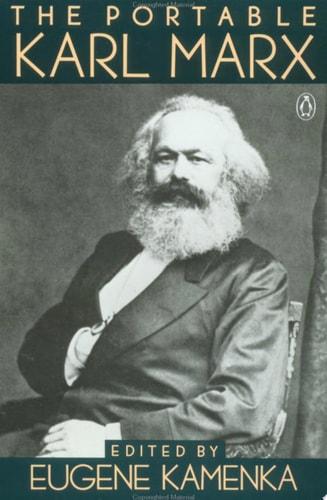
"The Portable Karl Marx" by Karl Marx, edited by Eugene Kamenka, is a collection of Marx's most significant writings. The book serves as an introduction to his work, covering his philosophical, social, economic, and political ideas 【2】【5】.
Key themes and topics explored in the book include:
* **Communism and Socialism:** The book contains the complete "Communist Manifesto" 【1】【5】 and discusses Marx's influence as a socialist thinker 【2】.
* **Economic Theory:** Selections from "Capital," "Wage-Labour and Capital," and the "Economic and Philosophical Manuscripts of 1844" are included, exploring concepts like the interaction between productive forces and social relations, and the nature of labor 【1】【3】.
* **Historical Development:** Marx's ideas on how history evolves through the conflict between economic forces and social classes are a central theme 【4】【6】.
* **Philosophy and Social Science:** The book delves into Marx's philosophical underpinnings, including his "Theses on Feuerbach" and writings on "The Jewish Question" and "The German Ideology" 【1】【5】.
* **Revolution and Political Ideas:** Writings on the French Revolution and political theory are also featured 【1】【3】.
These themes can help you draw connections to other books in a library that discuss:
* **Political Philosophy:** Works by other political theorists, philosophers of history, and economists.
* **Economic Systems:** Books analyzing capitalism, socialism, and communism, as well as critiques of economic inequality.
* **Social Theory:** Texts exploring class struggle, historical materialism, and the development of societies.
* **The History of Ideas:** Works that trace the intellectual lineage of socialist and revolutionary thought.
* **Specific Works by Marx and Engels:** Other writings by Karl Marx or Friedrich Engels, such as "Das Kapital" or "The German Ideology" 【4】.