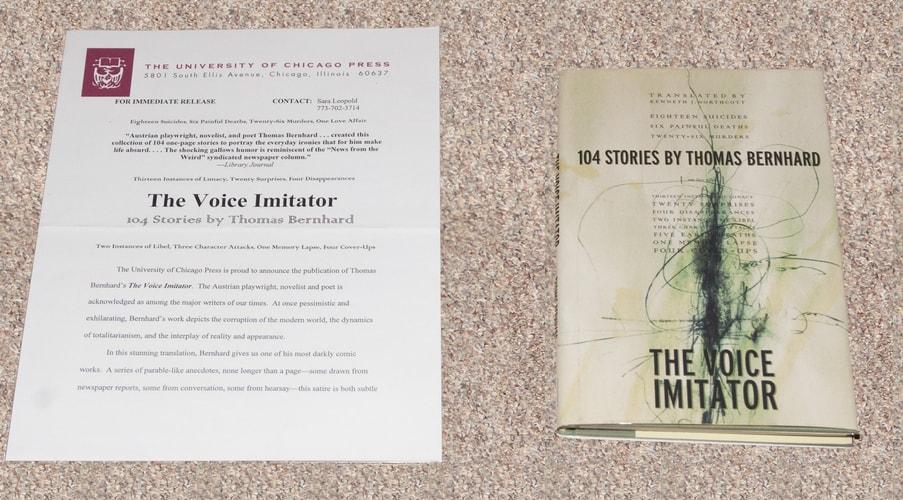
1. **Absurdism & the Grotesque in Everyday Life**
The book's 104 ultra-short anecdotes present an ordinary world that tips, without warning, into the bizarre and catastrophic. The normal and the grotesque sit side by side — a practical joke becomes institutionalisation, a love affair involves a shop-window mannequin — and the reader is never allowed to feel that rationality governs human affairs.

The book's central tension is: the mundane surface of modern life is paper-thin, and beneath it lies chaos, obsession, and ruin.

Connect to books about: absurdism, existentialism, the grotesque in literature, dark comedy, Kafka studies.

---

2. **Suicide, Madness & the Limits of the Self**
Characters across the collection — teachers, professionals, artists, civil servants — succumb repeatedly to self-destruction and mental collapse. These are not dramatic revelations but flat, reported facts, delivered with the same tone used for a weather update.

The book asks: what does it mean that breakdown and self-annihilation are so routine they read like news briefs?

Connect to books about: psychology of suicide, melancholia and depression in literature, mental illness and society, existential despair.

---

3. **Political Corruption & Totalitarianism**
Bernhard skewers politicians and bureaucrats throughout, exposing the machinery of Eastern European political oppression and the callousness of institutional power. Corruption is never sensational — it is procedural, banal, almost administrative.

The book's implicit argument is that power structures are not aberrations of modernity but its defining feature.

Connect to books about: political satire, authoritarianism, bureaucratic culture, Central European politics, Hannah Arendt, the banality of evil.

---

4. **Alienation & Institutional Indifference**
One of the book's shortest pieces — "Mail" — distils a defining theme: bureaucratic systems carry on regardless of human life or death, indifferent to the individual. Modern society's institutions register people only as data points, never as persons.

The book's central image is: a letter still arriving for the dead, and no one noticing.

Connect to books about: alienation, modernity and the individual, bureaucracy and dehumanisation, anomie, sociology of institutions.

---

5. **The Flash Fiction / Micro-Fiction Form as Meaning**
None of the 104 stories exceeds a single page; some are only two sentences. The extreme compression is not merely a stylistic choice — the brevity mirrors the arbitrariness and disposability of the lives described. Form enacts content: lives end abruptly, and so do the stories.

The parable-like structure owes much to the tradition of Kafka and the German-language literary parable.

Connect to books about: flash fiction, the short story form, literary minimalism, the parable tradition, experimental prose.

---

6. **Dark Satire & Misanthropy**
The book is relentlessly satirical toward the full spectrum of modern social types — politicians, tourists, artists, professionals — treating human folly with a tone that is at once deadpan and caustic. Bernhard's misanthropy is not nihilism but a rigorous, comic moral critique.

The humour is gallows humour: laughter as the only honest response to collective human failure.

Connect to books about: literary satire, black comedy, social critique, pessimist philosophy, Swift, Cioran, Schopenhauer.

---

7. **Austrian Identity, Culture & Self-Loathing**
The book is rooted in a distinctly Austrian cultural landscape — Salzburg, Vienna, the provinces — and carries Bernhard's famous love-hate relationship with his homeland. Austrian institutions, its art world, and its civic culture are recurring targets of contempt and dark comedy.

The book participates in a long tradition of Austrian writers using literature to indict Austrian society's repression, complacency, and provincialism.

Connect to books about: Austrian literature and history, post-war Austrian identity, the Habsburg legacy, European cultural criticism, Karl Kraus.

---

8. **Truth, Rumour & the Unreliable News Narrative**
The anecdotes are framed as being drawn from newspaper reports, hearsay, and overheard conversations — sources of questionable reliability. The journalistic, flat tone performs objectivity while describing the plainly absurd, raising constant questions about what counts as fact and how stories are constructed and circulated.

The book's deepest provocation