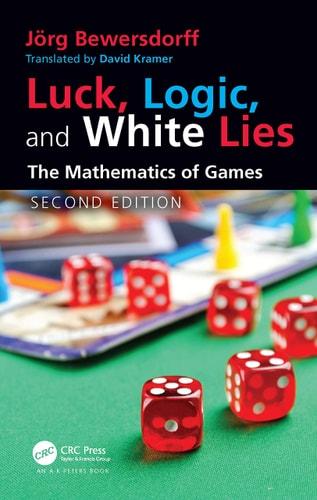
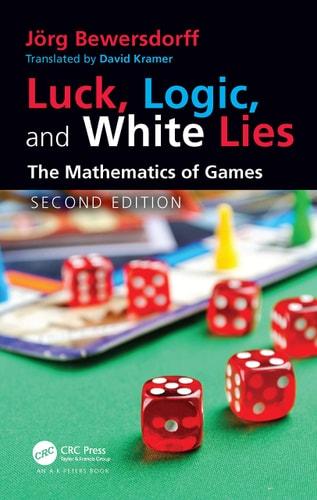
The book "Luck, Logic, and White Lies: The Mathematics of Games" by Jörg Bewersdorff explores the mathematical underpinnings of various games and game-like scenarios. It aims to introduce readers to the insights that mathematical knowledge can provide in analyzing problems and games, making it suitable for a broad audience including students, academics, and game enthusiasts 【4】【6】.

Key themes and topics covered in the book include:

*   **Games of Chance and Probability:** The book begins with games of chance, offering an accessible introduction to probability theory and statistical methods for analyzing luck-based games 【1】【10】. Specific examples include dice and lotteries 【10】.
*   **Combinatorial and Strategic Games:** It delves into combinatorial games, such as chess, where the vast number of possible moves makes complete analysis unfeasible, and explores mathematical approaches to these scenarios 【1】【2】.
*   **Game Theory:** The book touches upon the historical development of game theory, including combinatorial and strategic games 【2】【3】.
*   **Mathematical Analysis of Games:** A central theme is the application of mathematical methods to analyze specific games or game fragments 【2】【3】. This involves a wide range of techniques from mathematics, computing, and psychology 【9】.
*   **Historical Development:** The book includes a section on the historical evolution of theories related to games of chance, combinatorial games, and strategic games 【2】【3】.

The book is structured to gradually introduce mathematical concepts, making it a textbook-like resource for those with some mathematical background, while also offering nuggets of information for selective readers 【5】. It is praised for its clarity and its ability to introduce readers to a vast mathematical literature related to games 【8】. The book also includes mathematical notes, references, figures, and numerical tables to illustrate its topics 【7】.