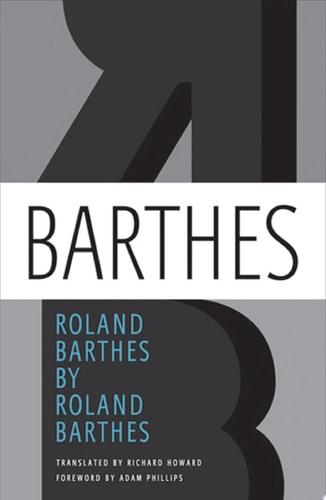
1. **The Autobiography as Anti-Genre**
*Roland Barthes by Roland Barthes* radically subverts the conventions of autobiography. Rather than offering a linear narrative of a life, Barthes treats himself as a text to be critically analyzed — fragmentary, contradictory, and unstable. The self here is not a fixed origin but a literary construction.

The book's central provocation is: can you write about yourself without creating a false, unified "author"? Barthes writes about himself in the third person, constantly undermining any claim to authentic self-knowledge.

Connect to books about: memoir theory, life writing, auto-fiction, the unreliable narrator, postmodern self-representation.

---

2. **Semiotics & The Life of Signs**
Barthes approaches his own identity through the lens of semiology — the study of signs and their cultural meanings. He reads his own tastes, habits, and desires as a system of signs rather than as personal truths, turning his inner life into an object of structural analysis.

Language, for Barthes, is not simply a vehicle for expressing a pre-existing self — it is the very substance of which the self is made.

Connect to books about: semiotics, linguistics, structuralism, cultural codes, Ferdinand de Saussure, Charles Sanders Peirce.

---

3. **Poststructuralism & the Death of the Author**
The book enacts Barthes's own famous theoretical move — the "death of the author" — by refusing to let the biographical person ground the meaning of his texts. Identity is shown to be plural, shifting, and irreconcilable with any single, authoritative interpretation.

This positions the book as a lived demonstration of post-structuralist thought: meaning is always deferred, never settled.

Connect to books about: post-structuralism, deconstruction, Derrida, Foucault, literary theory, authorship and authority.

---

4. **Language, Writing & Self-Construction**
The book is deeply preoccupied with the act of writing itself — what it means to live a life *in* and *through* language. Barthes explores how style, tone, and rhetoric are never neutral, but always ideologically and personally charged.

His life, as he presents it, is inseparable from his writing; the two cannot be disentangled.

Connect to books about: philosophy of language, the writerly life, meta-fiction, rhetoric, the essay as form, writers on writing.

---

5. **Fragmentation & Non-Linear Form**
The book is structured as a mosaic of short, alphabetically organized fragments — anecdotes, aphorisms, theoretical musings, and images — that resist synthesis into a coherent whole. This form is itself an argument: the self cannot be narrated continuously without distortion.

The fragment, for Barthes, is not a limitation but an ethics of honesty about the nature of subjectivity.

Connect to books about: experimental prose, aphoristic writing, the essay tradition, Montaigne, Nietzsche's *Twilight of the Idols*, collage and form.

---

6. **The Body, Pleasure & Desire**
Barthes grounds abstract intellectual life in the body — its pleasures, its illnesses, its sensory encounters. His tuberculosis, his erotic attachments, his sensory tastes (food, music, texture) are given equal weight alongside theoretical ideas.

This reflects his broader project, seen in *The Pleasure of the Text*, of theorizing desire and pleasure as legitimate critical categories.

Connect to books about: phenomenology, the body in theory, desire and subjectivity, queer theory, Merleau-Ponty, *The Pleasure of the Text*.

---

7. **Ideology, Myth & Popular Culture**
Running beneath the personal text is Barthes's persistent concern with ideology — how cultural norms, bourgeois assumptions, and naturalized myths shape what we believe to be authentic or true about ourselves and the world.

Even in writing about his own life, Barthes remains alert to how the "natural" or "obvious" is always a cultural construction.

Connect to books about: cultural criticism, ideology, myth, Gramsci, Althusser, Roland Barthes's *Mythologies*, media and representation.

---

8. **The Intellectual as Subject & Object**
Barthes turns the critical gaze — normally directed outward at texts and culture — back on himself, making the intellectual the subject of their own analysis. This raises uncomfortable questions about self-knowledge, critical distance,