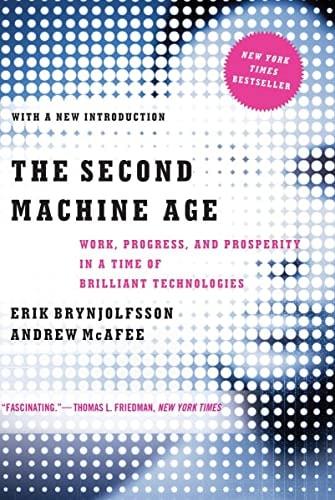
"The Second Machine Age: Work, Progress, and Prosperity in a Time of Brilliant Technologies" by Erik Brynjolfsson and Andrew McAfee explores the profound impact of **digital technologies** on society, the economy, and the labor market. The book argues that we are currently in a **"second machine age,"** characterized by rapid advancements in areas such as **artificial intelligence (AI), automation, big data, and networked computing** 【1】【5】.

Key themes and topics covered in the book include:

*   **Technological Transformation:** The book details how digital technologies are fundamentally reshaping industries and daily life, drawing parallels to the transformative impact of the Industrial Revolution 【5】【6】. It highlights specific examples like autonomous vehicles and AI achievements like IBM's Watson 【12】【13】.
*   **Economic Impact:** Brynjolfsson and McAfee examine the economic consequences of these technological advancements, introducing concepts like **"bounty"** (the overall economic abundance generated by technology) and **"spread"** (the increasing disparity in income and opportunities) 【2】【3】. They discuss how information technology has driven productivity surges 【11】 and the potential for technology to make human labor increasingly unnecessary for certain cognitive tasks 【1】【4】.
*   **The Future of Work:** A central focus is the changing nature of work and the labor market. The book discusses how automation and AI are beginning to perform tasks previously requiring human cognition, leading to a shift where machines become substitutes rather than complements to human labor 【1】【4】.
*   **Innovation and Progress:** The authors explore the nature of innovation in this new era, questioning whether it is declining or simply recombining existing elements 【2】. They also touch upon the ongoing relevance of **Moore's Law**, which predicts the exponential growth in computing power 【1】.
*   **Societal Implications:** The book delves into the broader societal effects of these technological shifts, including wealth inequality and the potential for job displacement 【8】【9】.

The book's interdisciplinary approach draws on insights from economics, computer science, and psychology, using numerous examples and case studies to illustrate its points 【7】. It is structured into sections that outline the characteristics of the second machine age, discuss its economic implications, and propose potential solutions to the challenges it presents 【3】【10】.