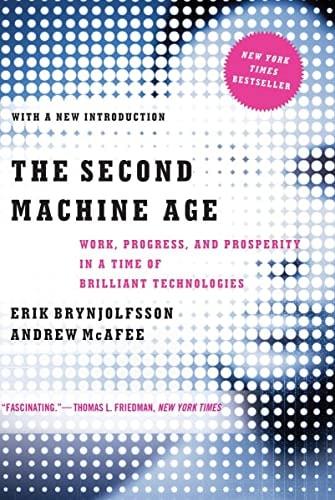
1. **Automation & the Future of Work**
   The book's central concern is that we have entered an era in which machines can automate or augment cognitive tasks that previously only humans could perform — a fundamental shift from the Industrial Revolution, which mechanized physical labour. Routine jobs in both manual and knowledge work are especially endangered, while non-routine roles in creativity, complex problem-solving, and caregiving may endure.

   The book's key tension is: as machines take over more cognitive labour, what meaningful role remains for human workers — and who bears the cost of displacement?

   Connect to books about: automation, the gig economy, technological unemployment, the future of professions.

---

2. **Exponential Technology & Moore's Law**
   Brynjolfsson and McAfee tie the current technological moment to the logic of exponential growth — computing power doubling at a near-constant rate — which makes the pace of change in the second machine age qualitatively different from all prior technological eras. The world is becoming increasingly digital, exponential, and combinatorial.

   The underlying idea is that human intuition is poorly equipped to grasp exponential curves, causing society to consistently underestimate the speed and scale of technological disruption.

   Connect to books about: the singularity, computing history, complexity theory, digital transformation.

---

3. **Economic Inequality & the "Spread"**
   While technology creates enormous aggregate wealth ("bounty"), the gains flow disproportionately to a small class of winners. Three drivers are identified: skill-biased technical change, the rise of capital income over labour income, and "superstar effects" — where the best performer in a field can serve global markets, crowding out everyone else.

   The book's uncomfortable paradox is: GDP and innovation reach historic highs even as median household incomes fall and pessimism about the future grows.

   Connect to books about: income inequality, winner-take-all markets, capital in the 21st century, labour economics.

---

4. **Artificial Intelligence & Machine Cognition**
   The authors document the emergence of machines that can process language, recognise patterns, drive cars, grade essays, and beat champions at *Jeopardy!* — tasks once considered exclusively human. This marks a threshold where machines begin to replicate the core of cognition, not just brute force computation.

   The book asks: if machines can think, what is the distinctive value of human intelligence — and how do we design systems where humans and machines complement rather than compete with each other?

   Connect to books about: AI ethics, machine learning, human-computer interaction, cognitive science.

---

5. **Innovation, Entrepreneurship & the Digital Economy**
   The authors argue that innovation is the engine of all economic growth, and that it accelerates as the number of intelligent agents — human and machine — increases. They champion reducing barriers to entrepreneurship, especially for software startups, and celebrate platform-based and crowd-sourced models of value creation.

   The broader argument is that the combinatorial nature of ideas means digital abundance, not scarcity, is the dominant logic of the new economy.

   Connect to books about: innovation theory, platform economics, startup culture, creative destruction.

---

6. **Education, Skills & Human Adaptability**
   Faced with rapid technological change, the authors argue that formal education systems are poorly suited to the demands of the second machine age. They call for investment in better teaching, curriculum reform, and lifelong reskilling programmes to help workers transition into roles that complement, rather than compete with, machines.

   The core challenge is: education historically prepares people for the economy that existed — not the one that is arriving.

   Connect to books about: the future of education, human capital, lifelong learning, workforce development.

---

7. **Measuring Prosperity Beyond GDP**
   A recurring theme is that standard economic measures like GDP fail to capture the true value generated by digital technologies — free services, improved quality of goods, and access to vast cultural and informational resources. The authors propose rethinking how we define and measure well-being in a digital economy.

   The underlying question is: if much of the value created in the second machine age is invisible to traditional metrics, are we systematically misreading the health of our society?

   Connect to books about: welfare economics, behavioural economics, happiness research, development economics.

---

8. **Policy, Governance & Technology**
   The final section of the book turns prescriptive: the authors recommend tax reform, universal basic income experiments, negative income taxes, and investment in public infrastructure to manage the social disruptions caused by automation. They insist that technology is