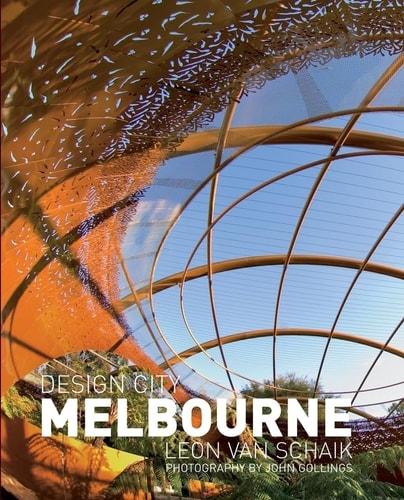
1. **Urban Design & Architectural Identity**
   At the heart of the book is a survey of Melbourne's built environment — its civic buildings, galleries, restaurants, apartments, and studios — read as expressions of a city's collective design identity. Van Schaik argues that the sum of these spaces constitutes something coherent and distinctive: a city that has genuinely become a "design city."

   The book's central question is: what does it mean for a city to have an architectural identity, and how does design culture give shape to urban life?

   Connect to books about: urban design theory, architectural criticism, place identity, city branding.

2. **Creative Cities & Urban Renaissance**
   Van Schaik positions Melbourne alongside Barcelona in the 1980s and Antwerp in the 1990s as a city that has undergone a design-led urban renaissance — a concentrated, historically specific flowering of creative culture that reshapes a city's global standing.

   The book asks how and why certain cities become creative hotspots at particular moments in history, and what sustains or undermines that momentum.

   Connect to books about: creative cities, cultural economy, urban regeneration, city competitiveness.

3. **Multiculturalism & Cultural Hybridity**
   Melbourne is presented as a cosmopolitan city navigating a tension between its European colonial heritage and a growing Asian cultural influence — pioneering, within that colonial matrix, new hybrid urban forms shaped by proximity to Asia.

   The book treats cultural plurality not as a problem to be managed but as the engine of Melbourne's design vitality.

   Connect to books about: multiculturalism, postcolonial urbanism, Asian-Pacific cultural exchange, diaspora and identity.

4. **Interior Space & Architecture of Everyday Life**
   Much of the book is devoted to interior spaces — bars, galleries, clubs, studios, apartments, beach houses — treated as culturally meaningful environments that shape and reflect the lives lived within them.

   Van Schaik argues that interiors are not merely decorative but are the primary sites where a city's design culture is expressed and experienced day to day.

   Connect to books about: interior design, spatial experience, architecture of everyday life, phenomenology of space.

5. **Patronage, Institutions & the Curation of Design Culture**
   A recurring concern is the role of individuals, institutions, and networks — particularly RMIT — in actively cultivating and sustaining a design culture. Van Schaik explores how patronage, editorial choices, and academic advocacy shape which creative work gets made and recognised.

   The book raises questions about who curates culture, whose work gets elevated, and the relationship between institutions and creative production.

   Connect to books about: cultural institutions, art patronage, academic influence, creative ecosystems.

6. **Practice-Based Research & Design Education**
   Van Schaik, as an Innovation Professor at RMIT, situates the book within a broader argument about design-as-research — the idea that architectural practice itself is a legitimate and rigorous form of knowledge production, not merely a craft or a service.

   This thread connects the built work shown in the book to debates about how design is taught, evaluated, and legitimised within universities.

   Connect to books about: design research methodology, architecture education, practice-led research, creative industries.

7. **Photography & Architectural Representation**
   With photography by John Gollings, the book is as much a visual argument as a written one. The photographs are not passive illustrations but active framing devices that shape how spaces are perceived and valued.

   This raises broader questions about how architecture is mediated — how buildings become "known" through images rather than direct experience, and what is gained or lost in that translation.

   Connect to books about: architectural photography, visual culture, representation in design, the image and the built environment.

8. **Critical Regionalism & Local Design Culture**
   The book insists on Melbourne's design culture as a genuinely localised phenomenon — rooted in a specific geography, intellectual community, and civic history — resisting the pull of globalised, generic architectural styles.

   Van Schaik's argument implicitly engages with critical regionalism: the idea that authentic architecture must be grounded in its particular place and culture, rather than imported wholesale from elsewhere.

   Connect to books about: critical regionalism, Australian architecture, vernacular design, globalisation and local identity.