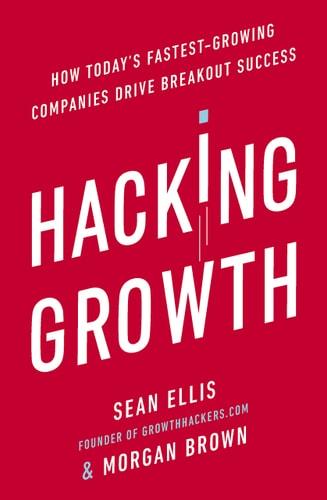
The book "Hacking Growth: How Today's Fastest-Growing Companies Drive Breakout Success" by Sean Ellis and Morgan Brown focuses on **growth hacking**, a methodology for achieving rapid business growth through rigorous analysis and rapid experimentation 【3】【10】.

Key themes and topics that can help draw connections to other books include:

*   **Growth Hacking Methodology**: The book outlines a systematic process for identifying, testing, and implementing growth opportunities 【7】【10】. This involves building **growth teams** that are cross-functional and collaborate across product management, marketing, and data analytics 【5】.
*   **Experimentation and Data-Driven Analysis**: A core concept is the continuous cycle of experimentation, driven by data analysis and insight gathering, to optimize growth levers 【1】【6】. This includes stages like idea generation, experiment prioritization, and execution 【1】.
*   **Customer Lifecycle Optimization**: The book details tactics for various stages of the customer journey, including **acquisition**, **activation**, **retention**, and **monetization** 【1】【4】. It emphasizes achieving product-market fit and eliciting an "aha" moment from customers 【4】.
*   **Building a Growth Culture**: "Hacking Growth" advocates for building a company culture centered around continuous experimentation to achieve breakout results 【1】【2】.
*   **Case Studies and Examples**: The book draws on examples from successful companies like Facebook, Dropbox, and Uber to illustrate growth tactics 【8】【11】.

These themes connect to broader topics such as:

*   **Startup Growth Strategies**: Books focusing on building and scaling startups, like "Startup Growth Engines" 【9】.
*   **Lean Methodologies**: Concepts related to rapid iteration and data-driven decision-making, similar to "The Lean Startup" 【2】.
*   **Digital Marketing and Analytics**: Works that delve into user acquisition, customer retention, and leveraging data for marketing insights.
*   **Organizational Design and Teamwork**: Books discussing the formation and function of high-performing, cross-functional teams.