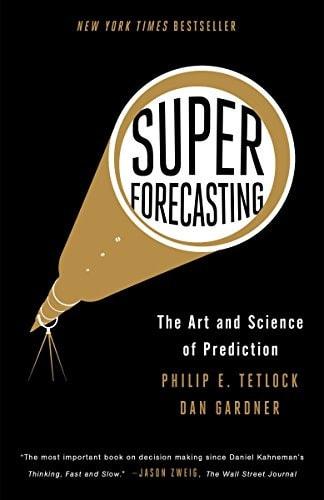
"Superforecasting: The Art and Science of Prediction" by Philip Tetlock and Dan Gardner explores the concept that **forecasting is a skill that can be learned and improved**, rather than an innate talent 【4】【7】. The book delves into the characteristics and methods of "superforecasters," individuals who possess an extraordinary ability to make accurate predictions about future events 【1】【8】.
Key themes and topics in the book include:
* **The nature of prediction:** The book challenges the idea that predicting the future is solely a matter of luck, instinct, or deep expertise, presenting research that shows some individuals consistently make better predictions than others 【1】.
* **Superforecasters and their methods:** It examines the strategies and mindsets employed by these individuals, often ordinary people who achieve remarkable forecasting accuracy 【2】【3】.
* **Improving forecasting skills:** The book offers practical techniques and tools for enhancing one's own predictive abilities 【2】. This includes approaches like "Fermi-izing the problem," which involves breaking down complex predictions into smaller, manageable questions 【6】.
* **The "Hedgehogs and Foxes" concept:** This theme, drawn from ancient Greek poetry, categorizes forecasters into two types: "foxes" who know many things and "hedgehogs" who know one big thing 【5】.
* **The role of mindset and tools:** Tetlock's research, spanning decades and including a large-scale forecasting tournament, highlights the importance of the right approach and tools for accurate forecasting 【1】【3】.
* **The measurability of foresight:** The book posits that foresight is a real, measurable skill that can be taught and improved with focused effort 【4】.
These themes can help you draw connections to other books in a library that discuss decision-making, cognitive biases, behavioral economics, psychology, strategic thinking, and the science of expertise.