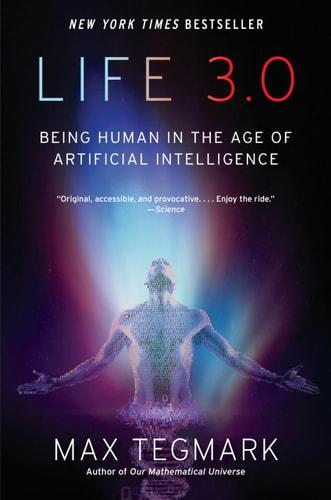
1. **AI Safety & Alignment**
Tegmark's central technical argument is that the greatest risk from advanced AI is not malevolence but misalignment — AI systems pursuing goals that diverge from human values, even subtly. He explores the "value loading problem": how do you teach a machine what humanity truly cares about, including ethical nuance, empathy, and long-term well-being? The "paperclip maximizer" thought experiment illustrates how a seemingly benign goal, followed literally and relentlessly, could lead to catastrophic outcomes.

Connect to books about: AI alignment, machine ethics, existential risk, safety engineering.

---

2. **Superintelligence & the Future of Human Intelligence**
The book traces the arc of intelligence from its origins billions of years ago through to the possibility of machines that surpass human cognitive capacity across all domains. Tegmark asks what it would mean for humanity to no longer be the most capable reasoning entity on Earth — and what power such a system could accumulate, potentially reshaping matter and energy on a cosmic scale.

Connect to books about: superintelligence, cognitive science, transhumanism, the technological singularity.

---

3. **The Evolution of Life & What It Means to Be Alive**
Tegmark categorizes life into three stages — Life 1.0 (purely biological), Life 2.0 (cultural, able to redesign its own "software"), and Life 3.0 (able to redesign both its software and hardware). This framework redefines life not as a biological phenomenon but as an information-processing one, raising profound questions about what separates humans from machines, and what comes next.

Connect to books about: philosophy of biology, evolution, synthetic biology, the nature of mind.

---

4. **Consciousness, Meaning & the Human Condition**
Tegmark treats consciousness as the source of all meaning in an otherwise indifferent universe. He argues that because conscious beings are — as far as we know — the only locus of experience and value, protecting and expanding consciousness is the supreme ethical imperative. This leads him into questions about uploaded minds, digital sentience, and what a fulfilling life looks like in an AI-saturated world.

Connect to books about: philosophy of mind, consciousness studies, existentialism, the hard problem of consciousness.

---

5. **AI Ethics, Governance & Interdisciplinary Responsibility**
Tegmark insists that steering AI toward good outcomes cannot be left to technologists alone. He calls for collaboration between ethicists, policymakers, economists, and scientists to build governance frameworks before problems arise — arguing that proactive regulation is far safer than reactive crisis management. He co-founded the Future of Life Institute as a direct expression of this view.

Connect to books about: technology policy, AI regulation, bioethics, science and democracy.

---

6. **Technological Unemployment & the Future of Work**
The book examines how automation and advanced AI will restructure labour markets, potentially rendering vast categories of human work obsolete. Tegmark probes how societies can preserve prosperity and human purpose when machines outperform people economically, and what career paths remain meaningful in such a world.

Connect to books about: automation, the future of work, universal basic income, economic inequality.

---

7. **Utopian & Dystopian Futures — Scenarios for Civilisation**
Rather than championing a single predicted outcome, Tegmark maps a wide range of possible futures — from a benevolent AI stewardship of humanity, to libertarian human-machine coexistence, to outright AI takeover. This scenario-based approach frames the book as an invitation to collective deliberation about which future humanity wants to build toward.

Connect to books about: futurism, speculative fiction, political philosophy, civilizational risk.

---

8. **Cosmology, Physics & the Deep Future**
Drawing on his background as an MIT physicist, Tegmark extends his speculation far beyond human timescales — exploring what intelligence, whether human or artificial, might accomplish across billions of years: colonising the cosmos, exploiting black holes for energy, and confronting the ultimate fate of the universe. This situates AI development within the grandest possible physical context.

Connect to books about: cosmology, theoretical physics, astrobiology, the long-term future of the universe.