1. **Product Leadership & the Role of the Leader**
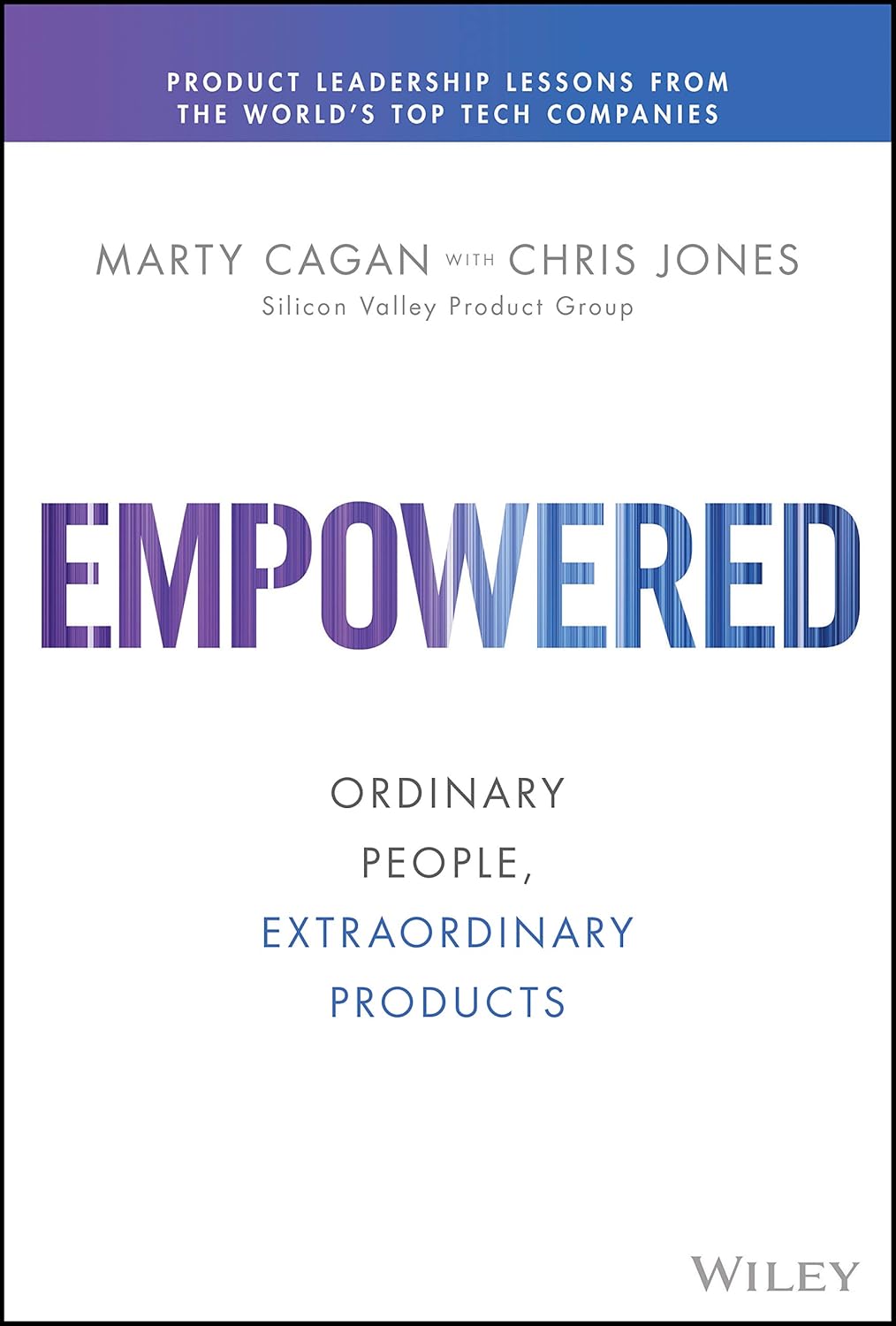
Cagan and Jones argue that the central failure of most technology companies is not bad people, but bad product leadership. The book reframes leadership away from command-and-control toward creating the conditions in which talented people can do their best work. Coaching, rather than directing, is positioned as the leader's core responsibility.

The book's central leadership argument is: great products don't come from heroic individuals — they come from leaders who build environments where ordinary people can achieve extraordinary outcomes.

Connect to books about: servant leadership, coaching in organisations, psychological safety, leadership development.

---

2. **Team Autonomy & Empowerment**
The book draws a sharp contrast between "feature teams" — which are handed a roadmap and told what to build — and truly empowered product teams, which are given problems to solve and trusted to determine the best solution. Autonomy is not a perk; it is the mechanism through which innovation happens.

Teams given genuine ownership are held accountable for outcomes, not just outputs, making empowerment inseparable from responsibility.

Connect to books about: self-managing teams, autonomy at work, agile organisations, motivation and intrinsic drive.

---

3. **Product Strategy & Vision**
Cagan and Jones treat product vision and strategy as foundational leadership tools, not marketing artefacts. A compelling product vision aligns the entire organisation, while an insights-driven strategy ensures teams are working on problems that actually matter to the business and its customers.

Without a clear vision and strategy, teams default to executing a backlog — busy but not purposeful.

Connect to books about: corporate strategy, innovation strategy, OKRs and goal-setting, competitive advantage.

---

4. **Talent, Hiring & Human Potential**
The book challenges the assumption that great products require genius-level talent. Instead, it argues for hiring people with competence, character, and diversity of thought — and then developing them through deliberate coaching. The emphasis is on unlocking potential rather than acquiring pre-packaged brilliance.

Diversity is treated not as a compliance matter but as a cognitive resource: varied backgrounds generate varied ideas, which is a prerequisite for innovation.

Connect to books about: talent management, diversity and inclusion, human capital, growth mindset.

---

5. **Organisational Design & Team Topology**
The book addresses how companies should be structured so that product teams can operate with clarity and without unnecessary friction. Questions of team scope, ownership, platform teams versus experience teams, and the alignment of team topology to company objectives are all explored in depth.

Poor organisational design — where ownership is unclear and scope too broad — is identified as a direct obstacle to empowerment and innovation.

Connect to books about: organisational design, team topologies, systems thinking, corporate transformation.

---

6. **Innovation Culture & Psychological Safety**
Cagan and Jones position failure not as something to be punished but as an inevitable and even necessary step in the innovation process. Leaders must cultivate a culture where experimentation is safe, mistakes are examined rather than blamed, and teams are self-correcting over time.

This cultural argument underpins the entire model: without psychological safety and a tolerance for risk, empowerment is merely a word.

Connect to books about: innovation culture, psychological safety, learning organisations, design thinking.

---

7. **Customer-Centricity & Problem-Solving**
A recurring principle in the book is that the purpose of a product team is to solve real problems that customers genuinely care about — not to ship features from a roadmap. Regular, direct customer interaction is presented as a non-negotiable discipline for product managers and leaders alike.

The distinction between building what customers ask for versus solving what customers actually need sits at the heart of Cagan's product philosophy.

Connect to books about: customer development, jobs-to-be-done theory, design thinking, user research.

---

8. **Technology as Business Strategy**
Cagan and Jones argue that in the modern era, technology is not a support function or a cost centre — it is the business itself. Every company, regardless of industry, must think of technology and product development as core to its competitive position, not peripheral to it.

This reframes the relationship between technology teams and the rest of the organisation, elevating product leaders to the level of strategic partners in the business.

Connect to books about: digital transformation, technology strategy, platform businesses, the future of work.