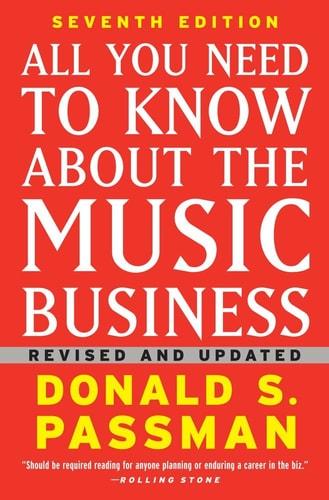
1. **Music Copyright & Intellectual Property**
Passman grounds much of the book in an explanation of what copyright means for musicians — what rights are created when a song is written, who owns them, and how they can be exploited or protected. Copyright is presented as the foundation upon which the entire publishing and licensing ecosystem rests.

The book traces how copyright ownership translates into revenue streams, including royalties, licensing fees, and catalog sales, making it essential knowledge for any creator or business professional in the industry.

Connect to books about: intellectual property law, copyright history, creative rights, patent and trademark law.

---

2. **Music Publishing & Royalties**
The book offers a detailed breakdown of how music publishing works — how songs generate income through mechanical royalties, performance royalties, sync licenses, and other revenue channels. Understanding these flows is presented as indispensable for any working songwriter or artist.

Passman demystifies complex structures like cross-collateralization and royalty computation, making them accessible to non-lawyers navigating their own careers and contracts.

Connect to books about: entertainment finance, royalty accounting, publishing contracts, creative economy.

---

3. **Record Deals, Contracts & Artist Representation**
The book walks readers through the full lifecycle of professional music relationships — how to build a team of advisors, structure their commissions and fees, and negotiate record deals. It treats the legal and contractual side of the industry as a skill artists must develop to protect themselves.

The power imbalance between artists and labels is a recurring undercurrent, with Passman guiding readers on how to negotiate from a position of greater awareness and strength.

Connect to books about: contract law, negotiation, talent management, entertainment law.

---

4. **The Streaming Revolution & Digital Economics**
A major theme of the book is how streaming fundamentally transformed the music business — shifting monetization from unit sales to per-play counts, and upending decades of established industry practice and economics. This is framed as the most significant disruption the industry has seen in its modern history.

The book examines how these changes ripple outward, altering the relationships between artists, labels, distributors, and platforms, and reshaping what constitutes a fair deal in the digital era.

Connect to books about: platform economics, digital disruption, attention economy, media industry transformation.

---

5. **Artist Empowerment & the Disintermediation of Gatekeepers**
Passman explores how artists today have more leverage than at any prior point in the industry's history — partly because streaming and social media allow them to reach audiences directly, without needing a label as an intermediary. This "new democracy for music" is positioned as both an opportunity and a challenge.

The rise of TikTok as a music discovery engine is treated as emblematic of this shift, where viral moments can launch careers independently of traditional industry machinery.

Connect to books about: creator economy, entrepreneurship, personal branding, independent media.

---

6. **Touring, Merchandising & Live Revenue**
Beyond recordings, the book covers how artists generate income through live performance, touring deals, and merchandise — revenue streams that have become increasingly central as recorded music income has been compressed by streaming rates.

These sections treat the business of live music as its own ecosystem, with its own contracts, fee structures, and negotiating dynamics distinct from the recording side.

Connect to books about: event management, live entertainment industry, brand licensing, sports & entertainment business.

---

7. **Emerging Technology, AI & the Future of Music**
The book engages directly with how artificial intelligence, Web3, and the metaverse are beginning to reshape music creation, distribution, and ownership. These are treated not as distant speculation but as present realities that industry participants must understand and navigate.

The tension between technological possibility and the legal/ethical frameworks designed to protect human creators gives this section a forward-looking urgency.

Connect to books about: AI ethics, future of work, creative industries and automation, blockchain and digital ownership.

---

8. **Music as a Financial Asset & Catalog Economics**
Passman addresses the growing phenomenon of music catalogs being acquired for tens or hundreds of millions of dollars by private equity firms and investment groups, treating songs and recordings as long-term financial assets. This reframes music not just as culture but as a commodity class.

This theme sits at the intersection of entertainment and finance, raising questions about who ultimately owns culture and what happens to creative works when they become investment vehicles.

Connect to books about: alternative investments, valuation of intangible assets, cultural economics, private equity.