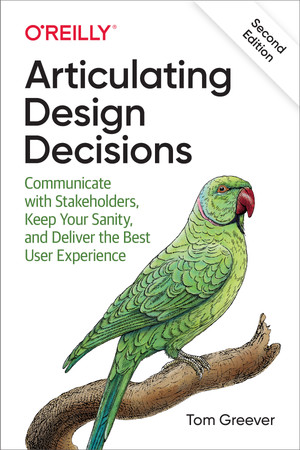
"Articulating Design Decisions" by Tom Greever focuses on the crucial skill of **communicating design rationale effectively to stakeholders** 【1】【3】. The book provides designers with strategies and techniques to clearly explain their choices, bridging the gap between design thinking and actionable execution 【1】【3】.

Key themes and topics that can help you draw connections to other books include:

*   **Communication and Persuasion:** The book emphasizes the importance of clear, concise, and compelling articulation of design ideas 【1】【10】. This connects to broader themes in books about public speaking, negotiation, and persuasive writing.
*   **Design Review Meetings:** A significant portion of the book is dedicated to optimizing meetings for design reviews, including strategies for retention (primacy, recency, surprise, repetition) and creating efficient environments 【7】【9】. This relates to books on meeting facilitation, project management, and effective collaboration.
*   **Stakeholder Management:** Greever provides guidance on how designers can build fruitful collaborations with stakeholders, understand their needs, and gain buy-in for their designs 【3】【6】. This theme connects to books on business communication, client relations, and leadership.
*   **Problem-Solving and Strategic Thinking:** The book encourages a strategic problem-solving approach in design projects to enhance business value 【4】. This links to books on critical thinking, design thinking methodologies, and business strategy.
*   **User Experience (UX) and Design Principles:** While focused on communication, the underlying goal is to deliver the best possible user experience 【5】. This connects to books specifically on UX/UI design, human-computer interaction, and usability.
*   **Removing Bias and Objectivity:** The book helps designers remove bias and speak eloquently about their choices 【8】. This relates to books on cognitive biases, decision-making, and critical analysis.

Essentially, "Articulating Design Decisions" is a practical guide that highlights the intersection of design, communication, and business, making it relevant to a wide range of disciplines beyond just design itself 【2】.