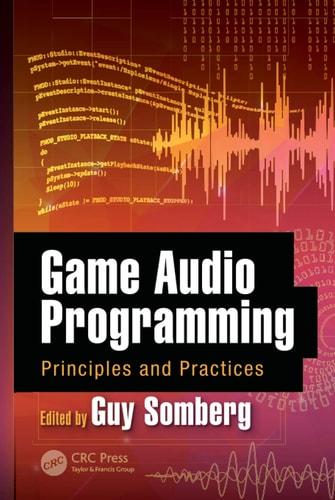
The book "Game Audio Programming: Principles and Practices" edited by Guy Somberg, delves into the technical aspects of creating sound for video games. It serves as a comprehensive guide for both aspiring and experienced game audio programmers and sound designers.
Key themes and topics covered in the book include:
* **Fundamentals of Game Audio:** The book covers the basic principles of audio representation and perception within the context of game development 【1】.
* **Audio Middleware:** It provides in-depth coverage of popular audio middleware platforms such as **Audiokinetic Wwise, CRI ADX2, and FMOD Studio** 【1】.
* **Advanced Audio Techniques:** Topics explored include **Vector-Based Amplitude Panning**, **Open Sound Control**, and **Dynamic Game Data** 【1】. More recent volumes also discuss **timed ADSRs**, **data-driven music systems**, **speech systems**, **asynchronous multithreaded audio engine architecture**, and **impulse responses** 【4】【6】.
* **Game Audio Engine Design:** The book offers insights into designing and implementing game audio engines, including both high-level and low-level concepts 【5】【7】.
* **Practical Application:** A significant focus is placed on practical application, with techniques and examples drawn from real-world game development, including AAA titles 【4】【5】.
* **Collaboration:** It addresses the collaboration between audio programmers and sound designers, offering perspectives on effective communication and workflow 【2】.
* **DSP and Low-Level Topics:** The book touches upon Digital Signal Processing (DSP) and other low-level audio programming concepts 【3】【8】.
* **Game Genres:** The techniques discussed are applicable across various game genres, such as ARPG, RTS, and FPS 【3】.
This book would be valuable for connecting with other resources on topics such as **game development**, **software engineering**, **digital signal processing**, **computer graphics (for multimedia integration)**, and **sound design**.