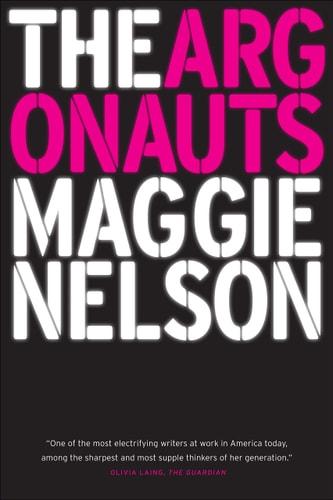
1. **Queer Identity & Gender Fluidity**
Nelson questions the need for labels while recognizing their importance, exploring gender and sexuality through self-reflection and her partner Harry Dodge's gender transition. She encourages embracing fluidity over fixity — in identity, desire, and self-definition — challenging readers to listen and engage without imposing normative frameworks.

The book's central argument is that gender and sexuality are not stable states but ongoing processes of becoming, always in motion.

Connect to books about: queer theory, gender studies, trans identity, sexuality and self-definition.

---

2. **Queer Family-Making & Non-Normative Kinship**
The Argonauts offers a firsthand account of building a family outside conventional structures — a queer partnership, a gender-transitioning partner, IVF pregnancy, step-parenting, and unconventional child-rearing — and interrogates what "family" can mean beyond heteronormative definitions.

Nelson asks what love, care, and commitment look like when stripped of inherited scripts, and finds richness in the improvised answers.

Connect to books about: LGBTQ+ parenting, kinship theory, alternative family structures, reproductive politics.

---

3. **The Body, Pregnancy & Physical Transformation**
Nelson and Dodge undergo simultaneous bodily transformations — her pregnancy and his testosterone treatments and top surgery — framing both as equally radical and equally queer acts of becoming. The book treats the body not as a fixed container but as a site of ongoing change and self-authorship.

Nelson also critiques traditional accounts of maternal sexuality and motherhood, reclaiming the body's complexity from reductive cultural narratives.

Connect to books about: embodiment, reproductive experience, trans embodiment, feminist body politics.

---

4. **Language, Naming & the Limits of Representation**
Nelson is preoccupied with what language can and cannot do — how words both liberate and constrain, how naming something risks fixing it, and how love and identity exceed available vocabulary. The title itself references Roland Barthes' idea that meaning must be perpetually rebuilt, like the Argonauts' ship, replacing parts without losing the whole.

Language, for Nelson, is a living entity shaped by experience — a vessel that must keep shapeshifting to hold an ever-changing life.

Connect to books about: philosophy of language, semiotics, Wittgenstein, the limits of representation, rhetoric and identity.

---

5. **Autotheory: Memoir Meets Critical Theory**
The Argonauts pioneered a form — autotheory — in which personal memoir is interwoven with philosophical and critical theory. Nelson weaves in Judith Butler, Eve Kosofsky Sedgwick, Gilles Deleuze, and Roland Barthes not as footnotes but as living voices inside her own experience.

This dissolves the boundary between the intellectual and the personal, arguing that theory is not separate from life but born from it.

Connect to books about: feminist theory, queer theory, essay and lyric essay traditions, experimental nonfiction, critical autobiography.

---

6. **Love, Intimacy & Radical Vulnerability**
At its heart, the book is a love story — but one that refuses sentimentality. Nelson explores how sustained intimacy requires constant renegotiation, how care and desire intertwine, and how loving someone who is changing (or who you fear may change beyond recognition) demands courage and openness.

The Argo metaphor drives this: love's identity persists even as every part of it is replaced.

Connect to books about: philosophy of love, intimacy and attachment, relationship dynamics, vulnerability and care ethics.

---

7. **Marriage, Domesticity & Queer Politics**
Nelson critiques the queer movement's centering of marriage equality as a political goal, suggesting it can narrow rather than expand queer possibility. Her own hasty wedding on the morning before the 2008 Prop 8 vote is rendered with both tenderness and ambivalence — she marries while questioning the institution itself.

This tension — between participating in and resisting normative structures — runs throughout her thinking on domesticity, family, and queer political life.

Connect to books about: marriage politics, homonormativity, LGBTQ+ civil rights, feminist critiques of domesticity.

---

8. **Grief, Death & the Cycle of Life**
The book ends with two simultaneous events: Nelson giving birth to Iggy, and Dodge sitting by his dying mother's bedside. This juxtaposition — new life and death woven together — gives the