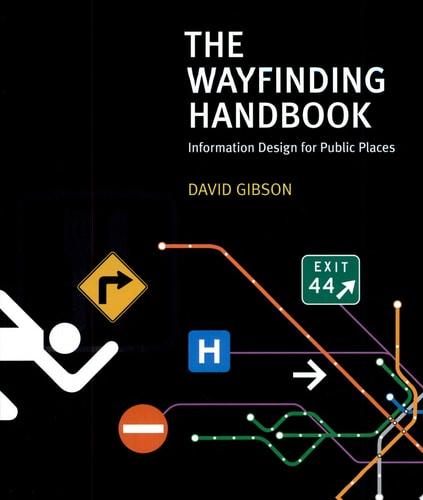
1. **Wayfinding & Human Spatial Navigation**
   At its core, the book addresses how people orient themselves and move through built environments — asking "Where am I?", "Where can I go?", and "How do I get out?" — and how design systems can answer those questions intuitively and safely.

   The central argument is that navigating space is a fundamental human cognitive and physical experience, and that thoughtful design can either support or frustrate that experience in profound ways.

   Connect to books about: cognitive mapping, environmental psychology, spatial cognition, urban navigation.

2. **Information Design & Visual Communication**
   Gibson examines how type, color, symbols, maps, and dimensional forms are orchestrated together to convey complex information clearly in public space — treating signage not as decoration but as a functional communication system.

   The book situates wayfinding within the broader discipline of information design, where the goal is always to reduce ambiguity and guide decision-making through visual means.

   Connect to books about: information architecture, data visualization, graphic communication, semiotics.

3. **Environmental Graphic Design**
   The book treats wayfinding as a subset of environmental graphic design — the practice of applying graphic language to physical space, including sign systems, identity programs, and placemaking elements in buildings and cities.

   Gibson draws on high-profile real-world projects — stadiums, hospitals, university campuses, and urban districts — to show how graphic decisions interact with architectural and landscape contexts.

   Connect to books about: environmental graphic design, signage systems, brand identity in space, architectural graphics.

4. **User-Centered Design & Accessibility**
   A persistent theme is designing for the full range of human users — diverse audiences with varying languages, abilities, and prior knowledge — making universal accessibility a core design requirement rather than an afterthought.

   Gibson frames good wayfinding as inherently democratic: it should serve everyone who passes through a space, including those with visual, cognitive, or physical differences.

   Connect to books about: universal design, inclusive design, human factors, accessibility standards.

5. **The Built Environment & Placemaking**
   The book explores how wayfinding systems contribute to the identity and legibility of a place — helping transform anonymous spaces into coherent, navigable environments that feel purposefully designed and welcoming.

   This connects wayfinding to broader questions about how architecture, landscape, and urban planning shape the human experience of cities and institutions.

   Connect to books about: placemaking, urban design, architecture and identity, sense of place.

6. **Cross-Disciplinary Design Practice**
   Gibson argues that effective wayfinding today demands fluency across graphic, architectural, landscape, interior, industrial, and information design — making it an inherently collaborative and multi-disciplinary field.

   The book reflects on how designers must work within teams alongside architects, planners, civic leaders, and project managers, requiring both creative and organisational skills.

   Connect to books about: design management, collaborative practice, interdisciplinary design, project management for creatives.

7. **Technology & the Evolving Landscape of Navigation**
   The book acknowledges that wayfinding is being transformed by kinetic media, GPS systems, web connectivity, and smart materials — pushing the discipline beyond static signage into dynamic, responsive systems.

   This raises questions about how physical and digital navigation systems relate to and complement each other in an increasingly connected world.

   Connect to books about: UX and digital navigation, smart cities, GPS and location technology, human-computer interaction.

8. **Typography & Cartography as Design Tools**
   Gibson gives sustained attention to the craft elements of wayfinding — particularly how typeface selection, letterform legibility, and mapmaking conventions directly determine whether a system succeeds or fails in the field.

   These are not decorative choices but functional decisions with measurable consequences for how quickly and accurately people can orient themselves.

   Connect to books about: typography, cartography and map design, legibility research, graphic standards.