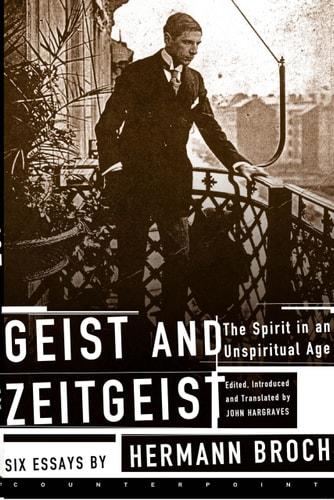
The book "Geist and Zeitgeist: The Spirit in an Unspiritual Age" by Hermann Broch explores several key themes and topics that can help in drawing connections to other books:
* **The Loss of Unifying Value Systems:** A central theme is Broch's belief that Western culture has lost its shared values, leading to an ethical and spiritual decline 【2】【5】. This idea can be connected to works that examine societal fragmentation, moral relativism, or the search for meaning in a secular world.
* **Ethical Responsibility:** The book delves into the problem of ethical responsibility in a world lacking a unified value system 【2】【4】. This connects to philosophical and literary works that grapple with morality, individual accountability, and the consequences of societal breakdown.
* **The Role of Literature and Art:** Broch viewed literature as a crucial medium for exploring human problems that cannot be addressed through rational means alone 【2】【4】. This theme allows for connections to books discussing literary theory, the philosophy of art, and the power of creative expression to understand the human condition.
* **The Spirit in an Unspiritual Age:** The title itself highlights a concern with the spiritual state of contemporary society, suggesting a critique of materialism or a lack of deeper meaning 【3】. This can link to books that explore spirituality, existentialism, or critiques of modern life.
* **Broch's Intellectual Background:** The essays in this collection reflect Broch's diverse interests, including philosophy, mathematics, sociology, and psychology 【1】. This interdisciplinary approach can be used to connect "Geist and Zeitgeist" with works that bridge different academic fields or explore the intersection of science, philosophy, and the humanities.
* **Myth and Culture:** One essay, "The Style of the Mythical Age," examines literature and myth, using older examples like Homer 【1】. This opens avenues for comparison with books on mythology, comparative literature, and the enduring power of narrative.
Broch's broader work, such as his novel "The Sleepwalkers," is also described as a "novel of an epoch" 【6】【7】, indicating a recurring interest in capturing the essence of a particular time period and its societal underpinnings.