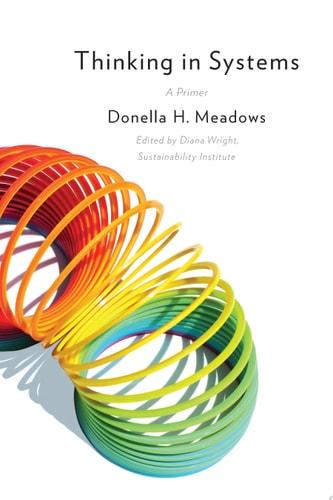
1. **Feedback Loops & Nonlinear Causality**
The book dismantles the assumption that A simply causes B. Systems are governed by feedback loops — reinforcing ones that amplify change, and balancing ones that resist it — meaning cause and effect are often circular, delayed, or disproportionate. A policy that looks logical in isolation can produce the opposite of its intended result.

The central challenge is that human intuition is wired for linear thinking, while the world operates nonlinearly.

Connect to books about: cybernetics, control theory, behavioral economics, cognitive biases, decision-making under uncertainty.

---

2. **Emergence & Complexity**
Systems produce behaviors that cannot be predicted or explained by examining their parts in isolation. The whole is genuinely different from the sum of its parts — a football team, an ecosystem, an economy each exhibit properties no single component possesses.

This theme sits at the heart of why reductionist analysis consistently fails to anticipate outcomes in complex domains.

Connect to books about: complexity science, emergence, chaos theory, network theory, evolutionary biology.

---

3. **Resilience, Stability & Self-Organisation**
Meadows explores how systems maintain themselves, absorb shocks, and in some cases reorganise entirely. A system capable of evolving its own structure — rather than just resisting change — is the most resilient of all. Stocks act as buffers against sudden disruption, creating the lag time that gives systems their characteristic inertia.

Connect to books about: ecological resilience, organisational resilience, antifragility, adaptive systems, crisis management.

---

4. **Leverage Points & Systemic Change**
Rather than fixing symptoms, Meadows argues that meaningful change requires identifying the precise structural points in a system where a small intervention produces a large shift. Most intuitive intervention points turn out to be weak; the most powerful leverage points are often the least obvious — such as changing the goals or paradigms of a system.

Connect to books about: organisational change, policy design, social innovation, strategic thinking, institutional reform.

---

5. **Limits to Growth & Resource Constraints**
Drawing on her foundational work on *The Limits to Growth*, Meadows shows how systems governed by finite stocks and exponential demand inevitably hit constraints. The "law of the minimum" holds that performance is capped by the scarcest resource, not the most abundant — a principle with profound implications for economics, ecology, and agriculture.

Connect to books about: environmental economics, sustainability, degrowth, planetary boundaries, population dynamics.

---

6. **Bounded Rationality & Unintended Consequences**
Individuals within a system make locally reasonable decisions based on incomplete information, yet collectively produce outcomes no one intended or desired. This explains why replacing individual actors rarely changes systemic outcomes — the structure of the system itself shapes behaviour, regardless of who occupies any given role.

Connect to books about: game theory, institutional economics, public policy failure, social traps, the tragedy of the commons.

---

7. **Mental Models & the Limits of Knowledge**
Every map, word, and theory is a model — a simplification that can never fully represent reality. Systems thinking insists on humility about what we can know, and recognises that the boundaries we draw around systems are artificial constructs we impose for convenience, not natural divisions in the world.

Connect to books about: epistemology, philosophy of science, cognitive psychology, forecasting, the nature of models and maps.

---

8. **Ecology, Environment & Sustainability**
Meadows consistently grounds her systems concepts in ecological and environmental examples — fisheries, climate, soil, population — treating the natural world as the most instructive laboratory for systems behaviour. Her work is inseparable from the broader project of understanding how human civilisation interacts with planetary systems.

Connect to books about: environmental science, ecological economics, climate change, conservation biology, earth system science.