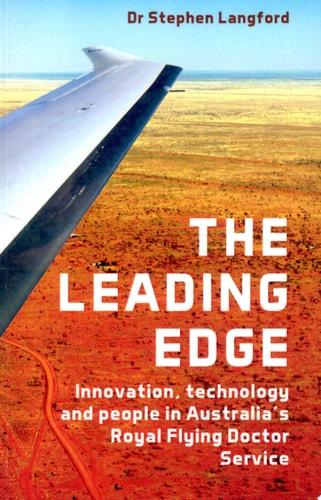
1. **Aeromedical Innovation & Technology Adoption**
The book traces how the RFDS evolved from adapted aircraft and pedal radios to jets, ultrasound, clot-busting drugs, and advanced diagnostic tools — documenting a continuous cycle of identifying clinical need and deploying cutting-edge technology to meet it in extreme conditions.

The central argument is that technological adoption is not passive: it requires champions within institutions willing to push through new tools and methods against logistical, geographic, and bureaucratic resistance.

Connect to books about: medical technology history, biomedical engineering, aviation medicine, healthcare innovation management.

---

2. **Remote & Rural Healthcare Delivery**
At its heart, the book is about solving the fundamental problem of providing high-quality medical care to people separated from hospitals by thousands of kilometres of outback. It examines how distance, terrain, and sparse population shape every clinical and operational decision.

The challenge of remoteness forces creative solutions that often exceed the standard of care available even in urban settings, making the RFDS a case study in resource-constrained excellence.

Connect to books about: rural health policy, global health equity, primary care in underserved communities, telemedicine.

---

3. **Australian History & National Identity**
The RFDS is woven into Australia's national mythology as an expression of ingenuity, egalitarianism, and the "fair go" — the idea that geography should not determine whether you live or die. Langford's account reinforces this by showing how the organisation became an enduring symbol of the Australian character.

The book sits within a broader tradition of histories that use iconic institutions to explore what Australians value and how they understand themselves as a people.

Connect to books about: Australian social history, outback culture, national identity, Federation-era institutions.

---

4. **Institutional Leadership & Organisational Change**
Langford spent over three decades as both frontline doctor and medical director, giving him a rare dual perspective on how a large, federated organisation navigates change. The book documents the internal politics, board decisions, and advocacy required to modernise the RFDS fleet and its clinical capabilities.

It is as much a management narrative as a medical one — showing how vision, persistence, and coalitions of support drive institutional transformation.

Connect to books about: leadership in healthcare, change management, nonprofit governance, organisational culture.

---

5. **Aviation History & Aeromedical Operations**
A substantial portion of the book is devoted to aviation — aircraft selection, pressurisation challenges, helicopter operations, and the physics of flight as they intersect with patient care. The push to secure the RFDS's first jet aircraft is a central story of advocacy and modernisation.

This strand connects the book to a rich literature on aviation history, particularly the use of aircraft in service of humanitarian and emergency missions.

Connect to books about: aviation history, search and rescue operations, military aeromedical evacuation, aircraft engineering.

---

6. **Indigenous Health & Health Equity in Australia**
Langford's work with the RFDS brought him into sustained contact with remote Indigenous communities, and the book addresses the particular health burdens and geographic disadvantage faced by these populations. Improving health outcomes for Aboriginal and Torres Strait Islander people is a recurring dimension of the RFDS's mission.

The book thus engages with one of Australia's most pressing and unresolved public health challenges, situating the RFDS as a frontline actor in reducing Indigenous health disparities.

Connect to books about: Indigenous Australian health, social determinants of health, colonial health legacies, closing the gap policy.

---

7. **Emergency Medicine & Pre-Hospital Care**
The book's detailed medical sections — covering trauma, cardiac emergencies, premature births, respiratory crises, and more — constitute a practitioner's account of how pre-hospital care evolved over four decades. The RFDS effectively functions as a flying intensive care unit, and Langford documents the clinical protocols developed for an airborne environment.

This makes the book a significant contribution to the history of emergency and retrieval medicine, charting the professionalisation of a field that barely existed in formal terms when the RFDS began.

Connect to books about: emergency medicine, critical care transport, paramedic and retrieval medicine, trauma surgery.

---

8. **Science, Engineering & Problem-Solving Under Constraint**
From designing aircraft medical interiors to adapting equipment for altitude and pressurisation effects on expanding gases, the book is filled with examples of applied science and engineering creativity. Solutions had to work reliably in a moving, vibrating, pressurised cabin far from any backup.

This theme connects the book to the broader literature on engineering