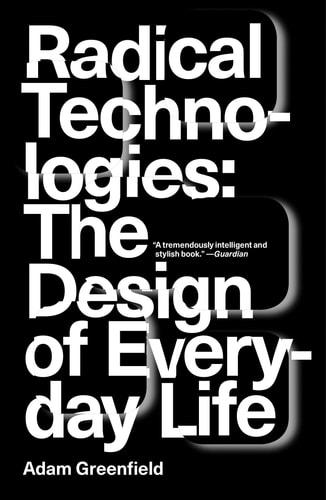
1. **The Colonisation of Everyday Life by Technology**
Greenfield's central concern is how radical technologies — smartphones, augmented reality, the Internet of Things, and more — have quietly embedded themselves into the fabric of daily existence, reshaping behaviour and experience without public deliberation or democratic consent.

The book argues that everyday life is now the primary terrain on which technological power operates, and that this colonisation happens largely invisibly, through convenience and habit rather than explicit choice.

Connect to books about: technology and society, ubiquitous computing, digital culture, the quantified self.

---

2. **Corporate Power & the Silicon Valley Consensus**
Greenfield is sharply critical of the small number of technology corporations that determine the design of systems billions of people depend on, arguing that innovation as practised in Silicon Valley entrenches existing concentrations of wealth and power rather than disrupting them.

He calls for a fundamental re-evaluation of who controls the technological infrastructure of modern life and in whose interests it is designed.

Connect to books about: platform capitalism, tech monopolies, corporate power, political economy of technology.

---

3. **Automation, Labour & the Future of Work**
A dedicated chapter examines how automation — from self-driving vehicles to algorithmic management — threatens to annihilate vast categories of human work, raising urgent questions about economic organisation, identity, and what it means to live a purposeful life in a post-labour economy.

Greenfield treats this not as an inevitable progress narrative but as a deeply political choice with profound distributional consequences.

Connect to books about: automation and employment, universal basic income, post-work futures, labour economics.

---

4. **Machine Learning, AI & the Eclipse of Human Discretion**
Greenfield examines how machine learning systems are now capable of producing knowledge and making decisions in domains once considered uniquely human — from strategic games to medical diagnosis — and interrogates what is lost when algorithmic judgement replaces human discretion.

He is especially concerned with the opacity of these systems and the degree to which their logic is inaccessible even to their designers.

Connect to books about: AI ethics, algorithmic decision-making, explainability, human–machine relations.

---

5. **Blockchain, Cryptocurrency & the Reordering of Trust**
Greenfield provides a critical account of blockchain technology and cryptocurrency, exploring their promise to disintermediate institutions — from banks to governments — and their potential to enable entirely new forms of economic and social organisation, while questioning whether these promises hold up under scrutiny.

He frames blockchain as an attempt to replace social and institutional trust with computational guarantees, and asks what kind of society that implies.

Connect to books about: cryptocurrency, decentralised finance, trust and institutions, digital money.

---

6. **The Internet of Things & Networked Environments**
Greenfield examines the emerging world of always-on, interconnected objects and environments — sensors, smart appliances, wearables — and the vast mesh of data collection and automated response this creates, largely without users understanding or consenting to the underlying dynamics.

He draws attention to the ideology of ease and convenience that obscures the surveillance and dependency embedded in connected systems.

Connect to books about: smart cities, ubiquitous computing, data collection, privacy and the networked home.

---

7. **Technological Utopianism vs. Critical Realism**
Throughout the book, Greenfield positions himself as a counter-voice to the pervasive optimism of tech culture, systematically examining the gap between the transformative promises made for each technology and their actual social consequences when deployed in the real world.

This tension between utopian rhetoric and critical analysis runs through every chapter, making the book a sustained exercise in puncturing techno-solutionism.

Connect to books about: technology criticism, solutionism, futures studies, philosophy of technology.

---

8. **Technology, Identity & the Atomisation of Society**
Greenfield explores how the personalisation logic built into networked technologies tends to fragment shared experience and individualise social life, eroding the common ground on which collective identity and political action depend.

The book asks what kind of self is produced by an environment of constant connectivity, algorithmic curation, and mediated reality — and what is forfeited when experience becomes irreducibly individual.

Connect to books about: identity and technology, social atomisation, community, digital psychology.