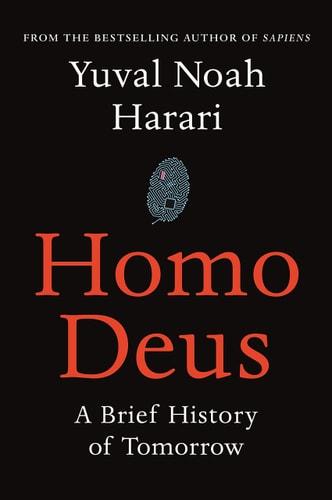
1. **The Future of Human Evolution & Transhumanism**
Harari argues that having largely conquered famine, plague, and war, humanity's new agenda is to transcend biology itself — pursuing immortality, engineered happiness, and godlike power. The book's central vision is of *Homo deus*: a post-human species wiser, healthier, and more capable than anything evolution produced.

The book's driving question is: what does humanity strive for once survival is no longer the primary struggle?

Connect to books about: transhumanism, human enhancement, bioethics, evolutionary futures, longevity science.

---

2. **Dataism & the Algorithmisation of Life**
Harari introduces Dataism as an emerging ideology: the belief that the universe consists of data flows and that all value — including human value — lies in the ability to process information. In this framework, humans are themselves complex algorithms, and their inner lives are reducible to biochemical computation.

The book's central provocation is that if non-conscious algorithms can outperform humans in decision-making and creativity, the very concept of human agency becomes obsolete.

Connect to books about: information theory, big data, algorithmic governance, philosophy of mind, cybernetics.

---

3. **Artificial Intelligence & the Displacement of Human Agency**
Harari warns that advances in AI could lead to a future where machines surpass human intelligence and decision-making capacity entirely. He questions whether consciousness has any intrinsic value in a world where raw intelligence — divorced from inner experience — determines relevance and power.

The spectre haunting the book is a civilisation that builds tools so capable they render their creators redundant.

Connect to books about: AI ethics, automation and the future of work, machine consciousness, technological unemployment, superintelligence.

---

4. **Biotechnology, Genetic Engineering & the Redesign of Human Nature**
The book examines how genetic engineering, nanotechnology, and brain-computer interfaces are already beginning to blur the boundary between the biological and the designed. Harari traces a trajectory from healing the sick to enhancing the healthy to engineering entirely new kinds of minds and bodies.

The ethical stakes are enormous: who controls these technologies, and who gets access to their benefits?

Connect to books about: genetic engineering, bioethics, CRISPR, neuroenhancement, the philosophy of medicine.

---

5. **Humanism, Religion & the Search for Meaning**
Harari argues that humanism — the belief in the unique sanctity and authority of human experience — is itself a kind of religion, one that emerged from the Scientific Revolution to replace theistic faith. He traces how liberal democracy, capitalism, and individualism all rest on this humanist foundation, and asks what happens to meaning-making when that foundation is eroded by technology.

The book frames the crisis of modernity as a crisis of narrative: which story do we tell ourselves about why human life matters?

Connect to books about: secularism, the philosophy of religion, existentialism, the history of ideas, moral philosophy.

---

6. **Consciousness, Free Will & the Self**
Throughout the book, Harari interrogates whether consciousness is anything more than a byproduct of data processing, and whether free will is an illusion generated by biochemical algorithms we do not control. These are not abstract philosophical puzzles — they have direct implications for law, ethics, politics, and identity.

The book asks: if we are our algorithms, is there a "self" left to protect or empower?

Connect to books about: philosophy of mind, neuroscience, free will, the hard problem of consciousness, cognitive science.

---

7. **Power, Inequality & the Rise of a Cognitive Elite**
Harari raises the troubling possibility that the benefits of biotechnology and AI will not be shared equally — that an enhanced cognitive and biological elite could emerge, widening inequality to a degree that makes current disparities look trivial. Those who can afford to upgrade themselves may diverge so far from the rest of humanity as to constitute a different species in practice.

The book implicitly asks: who owns the future, and who gets left behind?

Connect to books about: inequality, techno-capitalism, political economy, social stratification, the ethics of enhancement.

---

8. **Storytelling, Collective Belief & Social Order**
A foundational argument in the book is that humanity's dominance rests not on physical strength or individual intelligence, but on the unique ability to create and share fictional narratives — money, nations, corporations, religions — that allow millions of strangers to cooperate. Harari sees this capacity for collective myth-making