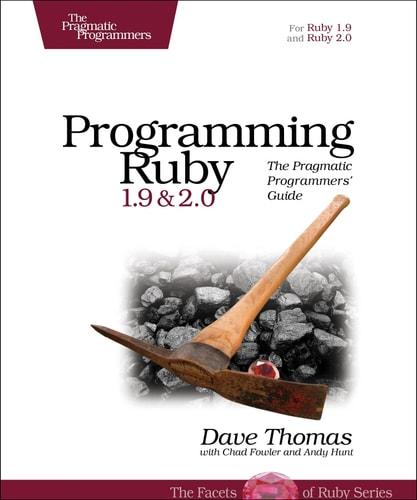
"Programming Ruby: The Pragmatic Programmer's Guide" by Dave Thomas, Chad Fowler, and Andy Hunt is a comprehensive tutorial and reference for the **Ruby programming language** 【2】【3】. It aims to make programming more enjoyable and productive by focusing on the creative aspects of coding 【8】.

Key themes and topics covered in the book that can help draw connections to other library books include:

*   **Ruby Language Fundamentals**: The book delves into the core of the Ruby language, explaining its syntax, expressions, and design features 【4】. It covers concepts like classes, objects, and methods, explaining how Ruby objects are structured and how classes function 【7】.
*   **Object-Oriented Programming (OOP)**: As Ruby is an object-oriented language, the book extensively covers OOP principles, including classes, objects, inheritance, and polymorphism.
*   **Programming Paradigms**: The book implicitly touches upon the **pragmatic programming** approach, emphasizing writing better code and being more productive 【2】【3】.
*   **Software Development Practices**: The authors, being "Pragmatic Programmers," likely incorporate best practices and efficient coding techniques throughout the book 【2】【3】.
*   **Standard Libraries and Modules**: It covers Ruby's standard library modules, providing practical information on using them for various tasks 【9】【10】.
*   **Web Development and Networking**: The book includes information on using Ruby with the web and accessing network services, including low-level socket support for implementing clients and servers 【1】【6】.
*   **GUI Development**: It touches upon creating GUI applications using Tk 【1】.
*   **Platform-Specific Development**: The book offers guidance on using Ruby in a Microsoft Windows environment, including native API calls, COM integration, and Windows Automation 【1】.
*   **Documentation Tools**: It introduces Ruby's built-in documentation format, RD, and the `rdtool` utility for converting documentation 【5】.

This book can be connected to other library resources on:

*   **General Programming Concepts**: Books on computer science fundamentals, algorithms, and data structures.
*   **Other Programming Languages**: Comparative studies of programming languages, or books on languages with similar paradigms (e.g., Python, Perl).
*   **Software Engineering**: Books on software design patterns, agile methodologies, and software architecture.
*   **Web Development Frameworks**: Resources on frameworks like Ruby on Rails, which heavily utilize Ruby.
*   **Scripting Languages**: Books on other scripting languages and their applications.