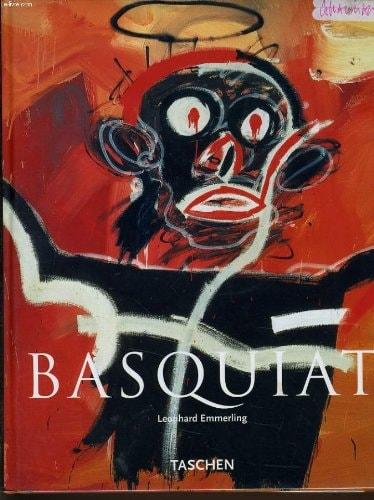
1. **Race, Racism & Racial Identity**
Basquiat's work is built on a fierce critique of racial injustice and the structures of power that sustain it. Emmerling traces how Basquiat — a Black artist of Haitian and Puerto Rican descent — navigated and challenged a predominantly white art world, embedding his paintings with coded commentary on discrimination, exploitation, and Black identity in America.

The book's core tension is the experience of being simultaneously celebrated and othered: the art market lionized Basquiat while treating him as an exotic commodity, a contradiction the work itself relentlessly interrogated.

Connect to books about: African American studies, Critical Race Theory, Black artistic traditions, the African diaspora.

---

2. **Street Art, Graffiti & the Legitimacy of Urban Expression**
Basquiat began as a graffiti artist under the tag SAMO, writing cryptic phrases across SoHo's walls before crossing into gallery spaces. Emmerling frames this trajectory as a foundational question: what counts as legitimate art, who decides, and what is lost or gained when the street enters the institution?

The book documents a pivotal cultural moment when urban visual culture crashed into the fine art establishment, permanently reshaping both.

Connect to books about: graffiti and street art history, urban culture, public art, subcultural movements.

---

3. **Neo-Expressionism & 1980s New York Art World**
Basquiat's raw, visceral canvases — merging text, symbol, and figuration — place him at the center of the Neo-Expressionist movement that defined the 1980s art scene. Emmerling situates him alongside contemporaries like Andy Warhol and Cy Twombly, mapping an era of explosive creative and commercial energy in New York.

The decade saw art become both a radical social statement and a high-stakes financial commodity, and Basquiat embodied both extremes at once.

Connect to books about: Neo-Expressionism, the 1980s New York art scene, art market history, postmodern art.

---

4. **Art as Social & Political Commentary**
Basquiat used painting as a form of protest, embedding critique of power structures, capitalism, colonialism, and racial violence within an apparently child-like visual surface. Emmerling decodes the hidden meanings in many paintings, revealing a deeply intellectual artist using aesthetics as a political weapon.

The book argues that Basquiat's seemingly chaotic imagery is in fact a carefully constructed vocabulary of dissent.

Connect to books about: art and politics, activist art, postcolonial theory, visual culture and power.

---

5. **Cross-Cultural & Transhistorical Influences**
Basquiat drew from an exceptionally broad well of references — Greek and Roman antiquity, African art and emblems, French Symbolist poetry, jazz, and contemporary American pop culture — weaving them into a single, urgent visual language. Emmerling shows how this synthesis was not decorative eclecticism but a deliberate assertion of a non-Western, non-linear art history.

This makes the book a rich entry point into questions of cultural appropriation, hybridity, and the politics of influence.

Connect to books about: African art history, cultural hybridity, art and music, influence and appropriation in the arts.

---

6. **Fame, the Art Market & the Commodification of the Artist**
Basquiat rocketed to global art-world fame by his early twenties, only to find himself trapped by the machinery of dealers, collectors, and celebrity. Emmerling examines how the market consumed and exploited Basquiat, turning the artist himself into a product — a tension Basquiat was acutely aware of and built directly into his work via the SAMO persona.

The book raises enduring questions about what the art market does to artists, and what artists can do in return.

Connect to books about: art market economics, celebrity culture, artistic autonomy, cultural capitalism.

---

7. **Identity, Self-Construction & the Outsider**
Basquiat's identity was composite and contested: Black, Caribbean-American, self-taught, homeless at one point, then feted by the global elite. Emmerling charts his progressive construction of a "discordant identity," one that refused to resolve into any single category — neither the respectable middle class his father embodied nor the street culture the art world wanted him to perform.

This theme makes the book deeply relevant to broader conversations about belonging, authenticity, and who gets to define an artist's identity.