M:N3:6 2
Edit position
Edit position

Last set 5 days, 3 hours ago. Manual moves override automatic placement until the next shelfie/spine match.

A crude look at the whole : the science of complex systems in business, life, and society
Diagnose this book
Open in Vernon Browser

A crude look at the whole : the science of complex systems in business, life, and society

by John H. Miller

This work explores the science of complex systems, arguing that social and economic challenges must be analysed as wholes rather than through isolated parts. It demonstrates how understanding interconnected patterns can help anticipate and solve major societal problems.

Accession 11437 ISBN 9780465055692 Publisher Basic Books
Book Images
Reference and live side by side Hover to see live images

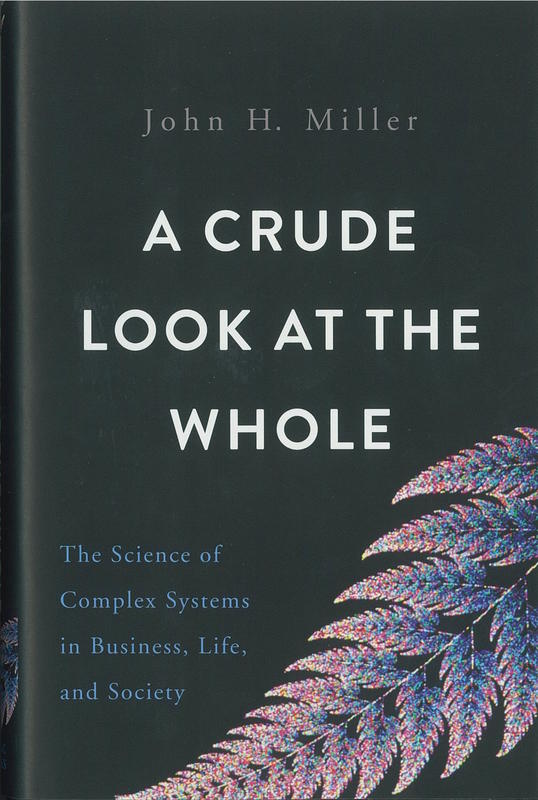
Reference
A crude look at the whole : the science of complex systems in business, life, and society spine
A crude look at the whole : the science of complex systems in business, life, and society cover
Live
A crude look at the whole : the science of complex systems in business, life, and society live spine
No live
A crude look at the whole : the science of complex systems in business, life, and society spine A crude look at the whole : the science of complex systems in business, life, and society live spine
A crude look at the whole : the science of complex systems in business, life, and society cover
No live
TAGS
Curated Derived
Culture Economics Engineering Philosophy Science Social Sciences
CONNECTIONS
No connections
State
on_shelf
True
position_updated_at
2026-06-01 16:33
orientation
vertical
Details

Physical

binding_type
Hard Back
dimensions
none captured
spine_text
none captured

Metadata

Book form
LOCATION HISTORY
M:N3:6 2 Current vertical
1 week, 3 days ago
Book Location
Updated 5 days, 3 hours ago
Vernon snapshot
View live

Frozen copy of Vernon's record from the last sync. Fields tagged flow back into the Pulse record.

Last synced 2026-05-21 00:53 (2 weeks, 2 days ago)

Identity

name→ title
A crude look at the whole : the science of complex systems in business, life, and society
vernon_id
15215
accession_no→ accession_number
11437
vernon_slug
a-crude-look-at-the-whole-the-science-of-complex-systems-in-business-life-and-society-john-h-miller

Drives Pulse state

curr_loc_status→ on_shelf
On Shelf
location_name
Zone N3/Level 2 (Mezzanine)/Phrontisterion/MONA
location_reason
On Shelf
isbn_issn→ isbn (when valid)
9780465055692

Descriptive

production_date
2015
object_type
Books/Document genres/Information forms/Visual and Verbal Communication
object_status
Accessioned
brief_description
On the science of reductionism. In A Crude Look at the Whole, social scientist and economist John H. Miller shows why we need to start looking at whole pictures. For one thing, whether we are talking about stock markets, computer networks, or biological organisms, individual parts only make sense when we remember that they are part of larger wholes. And perhaps more importantly, those wholes can take on behaviours that are strikingly different from that of their pieces.

Subjects & people

authors→ author (initial fill only)
John H. Miller
tags→ tags
Psychology, Philosophy, Social sciences, Civilisation, Choice (Psychology), Economics, Decision making, Chaotic behaviour in systems, System theory, Science -- Philosophy, Information modeling, System analysis, Reductionism
subject_people
subject_objects

Cover image

vernon_cover_image_id→ cover_image
18499

Raw Vernon JSON

click to inspect

The source payload behind the snapshot above.

Use ⌘F to search once expanded.
{7 keys}
"slug": "a-crude-look-at-the-whole-the-science-of-complex-systems-in-business-life-and-society-john-h-miller"
"opacObjectId": "15215"
"opacCollection": {1 keys}
"opacCollectionId": "1"
"imagesCollection": {2 keys}
"images": [1 items]
"[0]": {5 keys}
"imageId": "18499"
"cssColors": [4 items]
"[0]": {9 keys}
"hex": "708090"
"hue": 210
"rank": 1
"presence": 83.24
"colorName": "slategray"
"lightness": 50
"colorGroup": "gray"
"saturation": 13
"formattedColorName": "slate gray"
"[1]": {9 keys}
"hex": "c0c0c0"
"hue": 0
"rank": 2
"presence": 8.16
"colorName": "silver"
"lightness": 75
"colorGroup": "gray"
"saturation": 0
"formattedColorName": "silver"
"[2]": {9 keys}
"hex": "696969"
"hue": 0
"rank": 3
"presence": 4.5
"colorName": "dimgray"
"lightness": 41
"colorGroup": "gray"
"saturation": 0
"formattedColorName": "dim gray"
"[3]": {9 keys}
"hex": "778899"
"hue": 210
"rank": 4
"presence": 1.26
"colorName": "lightslategray"
"lightness": 53
"colorGroup": "gray"
"saturation": 14
"formattedColorName": "light slate gray"
"rawColors": [7 items]
"[0]": {6 keys}
"hex": "2e3637"
"hue": 186
"rank": 1
"presence": 83.24
"lightness": 19
"saturation": 8
"[1]": {6 keys}
"hex": "c5b5bc"
"hue": 333
"rank": 2
"presence": 8.16
"lightness": 74
"saturation": 12
"[2]": {6 keys}
"hex": "796f7b"
"hue": 290
"rank": 3
"presence": 4.5
"lightness": 45
"saturation": 5
"[3]": {6 keys}
"hex": "7683a4"
"hue": 223
"rank": 4
"presence": 1.26
"lightness": 55
"saturation": 20
"[4]": {6 keys}
"hex": "86a1ac"
"hue": 197
"rank": 5
"presence": 0.51
"lightness": 60
"saturation": 18
"[5]": {6 keys}
"hex": "485877"
"hue": 219
"rank": 6
"presence": 1.58
"lightness": 37
"saturation": 24
"[6]": {6 keys}
"hex": "527382"
"hue": 198
"rank": 7
"presence": 0.74
"lightness": 41
"saturation": 22
"imageLabels": [10 items]
"[0]": {5 keys}
"count": 19018
"score": 83.56
"status": "auto_verified"
"imageLabel": "Publication"
"imageLabelId": 23
"[1]": {5 keys}
"count": 19411
"score": 81.02
"status": "auto_verified"
"imageLabel": "Font"
"imageLabelId": 12
"[2]": {5 keys}
"count": 3985
"score": 67.37
"status": "auto_verified"
"imageLabel": "Electric blue"
"imageLabelId": 49
"[3]": {5 keys}
"count": 15171
"score": 66.24
"status": "auto_verified"
"imageLabel": "Book"
"imageLabelId": 67
"[4]": {5 keys}
"count": 12694
"score": 66.09
"status": "auto_verified"
"imageLabel": "Book cover"
"imageLabelId": 90
"[5]": {5 keys}
"count": 2395
"score": 63.7
"status": "auto_verified"
"imageLabel": "Event"
"imageLabelId": 46
"[6]": {5 keys}
"count": 942
"score": 60.54
"status": "auto_verified"
"imageLabel": "Carmine"
"imageLabelId": 74
"[7]": {5 keys}
"count": 5351
"score": 57.36
"status": "auto_verified"
"imageLabel": "Advertising"
"imageLabelId": 71
"[8]": {5 keys}
"count": 6
"score": 55.7
"status": "auto_verified"
"imageLabel": "Thread"
"imageLabelId": 623
"[9]": {5 keys}
"count": 5578
"score": 54.83
"status": "auto_verified"
"imageLabel": "Pattern"
"imageLabelId": 24
"imageDerivatives": [6 items]
"[0]": {4 keys}
"url": "https://browser.mona.net.au/records/images/large/3939/8eab81ddbe44017aa928e15805915f7f98596c51.jpg"
"width": "538"
"height": "800"
"identifier": "LARGE"
"[1]": {4 keys}
"url": "https://browser.mona.net.au/records/images/medium/3939/8eab81ddbe44017aa928e15805915f7f98596c51.jpg"
"width": "269"
"height": "400"
"identifier": "MEDIUM"
"[2]": {4 keys}
"url": "https://browser.mona.net.au/records/images/nano/3939/8eab81ddbe44017aa928e15805915f7f98596c51.jpg"
"width": "24"
"height": "35"
"identifier": "NANO"
"[3]": {4 keys}
"url": "https://browser.mona.net.au/records/images/small/3939/8eab81ddbe44017aa928e15805915f7f98596c51.jpg"
"width": "101"
"height": "150"
"identifier": "SMALL"
"[4]": {4 keys}
"url": "https://browser.mona.net.au/records/images/tiny/3939/8eab81ddbe44017aa928e15805915f7f98596c51.jpg"
"width": "50"
"height": "75"
"identifier": "TINY"
"[5]": {4 keys}
"url": "https://browser.mona.net.au/records/images/xlarge/3939/8eab81ddbe44017aa928e15805915f7f98596c51.jpg"
"width": "806"
"height": "1200"
"identifier": "XLARGE"
"totalImages": 1
"objectSearchScore": 0.3118719
"opacObjectFieldSets": [40 items]
"[0]": {2 keys}
"identifier": "accession_no"
"opacObjectFields": [1 items]
"[0]": {1 keys}
"value": "11437"
"[1]": {2 keys}
"identifier": "name"
"opacObjectFields": [1 items]
"[0]": {2 keys}
"value": "A crude look at the whole : the science of complex systems in business, life, and society / John H. Miller"
"opacObjectFieldAttributes": [1 items]
"[0]": {2 keys}
"key": "title"
"value": "A crude look at the whole : the science of complex systems in business, life, and society / John H. Miller"
"[2]": {2 keys}
"identifier": "other_name"
"opacObjectFields": [1 items]
"[0]": {1 keys}
"value": ""
"[3]": {2 keys}
"identifier": "artist_last_first"
"opacObjectFields": [1 items]
"[0]": {1 keys}
"value": "Miller, John H."
"[4]": {2 keys}
"identifier": "prod_pri_date"
"opacObjectFields": [1 items]
"[0]": {2 keys}
"value": "2015"
"opacObjectFieldAttributes": [2 items]
"[0]": {2 keys}
"key": "earliest_date"
"value": "2015-01-01Z"
"[1]": {2 keys}
"key": "latest_date"
"value": "2015-12-31Z"
"[5]": {2 keys}
"identifier": "prod_pri_date_notes"
"opacObjectFields": [1 items]
"[0]": {1 keys}
"value": ""
"[6]": {2 keys}
"identifier": "edition"
"opacObjectFields": [1 items]
"[0]": {1 keys}
"value": ""
"[7]": {2 keys}
"identifier": "brief_desc"
"opacObjectFields": [1 items]
"[0]": {1 keys}
"value": "On the science of reductionism. In A Crude Look at the Whole, social scientist and economist John H. Miller shows why we need to start looking at whole pictures. For one thing, whether we are talking about stock markets, computer networks, or biological organisms, individual parts only make sense when we remember that they are part of larger wholes. And perhaps more importantly, those wholes can take on behaviours that are strikingly different from that of their pieces."
"[8]": {2 keys}
"identifier": "measure_desc"
"opacObjectFields": [1 items]
"[0]": {1 keys}
"value": ""
"[9]": {2 keys}
"identifier": "credit_line"
"opacObjectFields": [1 items]
"[0]": {1 keys}
"value": ""
"[10]": {2 keys}
"identifier": "curr_loc_status"
"opacObjectFields": [1 items]
"[0]": {2 keys}
"value": "On Shelf"
"opacObjectFieldAttributes": [1 items]
"[0]": {2 keys}
"key": "search"
"value": "curr_loc_status:"On Shelf""
"[11]": {2 keys}
"identifier": "ob_status"
"opacObjectFields": [1 items]
"[0]": {1 keys}
"value": "Accessioned"
"[12]": {2 keys}
"identifier": "lender"
"opacObjectFields": [1 items]
"[0]": {1 keys}
"value": ""
"[13]": {2 keys}
"identifier": "copyright_owner"
"opacObjectFields": [1 items]
"[0]": {1 keys}
"value": ""
"[14]": {2 keys}
"identifier": "copyright_type"
"opacObjectFields": [1 items]
"[0]": {1 keys}
"value": ""
"[15]": {2 keys}
"identifier": "copyright_start"
"opacObjectFields": [0 items]
"[16]": {2 keys}
"identifier": "copyright_expiry"
"opacObjectFields": [0 items]
"[17]": {2 keys}
"identifier": "copyright_notes"
"opacObjectFields": [1 items]
"[0]": {1 keys}
"value": ""
"[18]": {2 keys}
"identifier": "curr_loc"
"opacObjectFields": [1 items]
"[0]": {1 keys}
"value": "Zone N3/Level 2 (Mezzanine)/Phrontisterion/MONA"
"[19]": {2 keys}
"identifier": "object_type"
"opacObjectFields": [1 items]
"[0]": {2 keys}
"value": "Books/Document genres/Information forms/Visual and Verbal Communication"
"opacObjectFieldAttributes": [1 items]
"[0]": {2 keys}
"key": "search"
"value": "object_type:"Books/Document genres/Information forms/Visual and Verbal Communication""
"[20]": {2 keys}
"identifier": "collection"
"opacObjectFields": [1 items]
"[0]": {2 keys}
"value": "Main Collection/Library"
"opacObjectFieldAttributes": [1 items]
"[0]": {2 keys}
"key": "search"
"value": "collection:"Main Collection/Library""
"[21]": {2 keys}
"identifier": "prod_pri_place"
"opacObjectFields": [1 items]
"[0]": {1 keys}
"value": "New York/United States of America"
"[22]": {2 keys}
"identifier": "prod_pri_publisher"
"opacObjectFields": [1 items]
"[0]": {1 keys}
"value": "Basic Books"
"[23]": {2 keys}
"identifier": "physical_notes"
"opacObjectFields": [2 items]
"[0]": {1 keys}
"value": "245 pages : illustrations ; 22 cm."
"[1]": {1 keys}
"value": "Includes bibliographical references and index."
"[24]": {2 keys}
"identifier": "language"
"opacObjectFields": [1 items]
"[0]": {1 keys}
"value": "English"
"[25]": {2 keys}
"identifier": "isbn_issn"
"opacObjectFields": [1 items]
"[0]": {1 keys}
"value": "9780465055692"
"[26]": {2 keys}
"identifier": "user_sym_1"
"opacObjectFields": [1 items]
"[0]": {1 keys}
"value": "003 MIL"
"[27]": {2 keys}
"identifier": "usual_loc_being"
"opacObjectFields": [1 items]
"[0]": {1 keys}
"value": "Zone N3/Level 2 (Mezzanine)/Phrontisterion/MONA"
"[28]": {2 keys}
"identifier": "subject_class"
"opacObjectFields": [5 items]
"[0]": {2 keys}
"value": "Chaotic behaviour in systems/System theory/Science -- Philosophy"
"opacObjectFieldAttributes": [1 items]
"[0]": {2 keys}
"key": "search"
"value": "subject_class:"Chaotic behaviour in systems/System theory/Science -- Philosophy""
"[1]": {2 keys}
"value": "Decision making/Choice (Psychology)/Psychology"
"opacObjectFieldAttributes": [1 items]
"[0]": {2 keys}
"key": "search"
"value": "subject_class:"Decision making/Choice (Psychology)/Psychology""
"[2]": {2 keys}
"value": "Economics/Social sciences/Civilisation"
"opacObjectFieldAttributes": [1 items]
"[0]": {2 keys}
"key": "search"
"value": "subject_class:"Economics/Social sciences/Civilisation""
"[3]": {2 keys}
"value": "Information modeling/System analysis/System theory/Science -- Philosophy"
"opacObjectFieldAttributes": [1 items]
"[0]": {2 keys}
"key": "search"
"value": "subject_class:"Information modeling/System analysis/System theory/Science -- Philosophy""
"[4]": {2 keys}
"value": "Reductionism/Philosophy"
"opacObjectFieldAttributes": [1 items]
"[0]": {2 keys}
"key": "search"
"value": "subject_class:"Reductionism/Philosophy""
"[29]": {2 keys}
"identifier": "subject_date"
"opacObjectFields": [0 items]
"[30]": {2 keys}
"identifier": "subject_event"
"opacObjectFields": [1 items]
"[0]": {1 keys}
"value": ""
"[31]": {2 keys}
"identifier": "subject_period"
"opacObjectFields": [1 items]
"[0]": {1 keys}
"value": ""
"[32]": {2 keys}
"identifier": "subject_object"
"opacObjectFields": [1 items]
"[0]": {1 keys}
"value": ""
"[33]": {2 keys}
"identifier": "subject_person"
"opacObjectFields": [1 items]
"[0]": {1 keys}
"value": ""
"[34]": {2 keys}
"identifier": "subject_place"
"opacObjectFields": [1 items]
"[0]": {1 keys}
"value": ""
"[35]": {2 keys}
"identifier": "assoc_person"
"opacObjectFields": [1 items]
"[0]": {1 keys}
"value": ""
"[36]": {2 keys}
"identifier": "assoc_place"
"opacObjectFields": [1 items]
"[0]": {1 keys}
"value": ""
"[37]": {2 keys}
"identifier": "assoc_event"
"opacObjectFields": [1 items]
"[0]": {1 keys}
"value": ""
"[38]": {2 keys}
"identifier": "assoc_object"
"opacObjectFields": [1 items]
"[0]": {1 keys}
"value": ""
"[39]": {2 keys}
"identifier": "user_sym_9"
"opacObjectFields": [1 items]
"[0]": {1 keys}
"value": ""
"relationshipsCollection": {2 keys}
"relationships": [1 items]
"[0]": {4 keys}
"relatedRecords": [1 items]
"[0]": {3 keys}
"slug": "john-h-miller"
"title": "John H. Miller"
"relatedRecordId": "15248"
"relationshipId": "object_prod_pri_person"
"relatedRecordType": "person"
"totalRelatedRecords": 1
"totalRelationships": 1
Topics and Themes
