Unpositioned
Edit position
Edit position

No position recorded yet. Picking a shelf here sets the manual override.

Grooming, gossip and the evolution of language / Robin Dunbar
Diagnose this book
Open in Vernon Browser

Grooming, gossip and the evolution of language / Robin Dunbar

by Robin Dunbar

This work explores the evolution of human language, proposing that it developed as a more efficient form of social grooming to maintain bonds in large groups. It examines the role of gossip and conversation in social cohesion and the necessity of face-to-face interaction.

Accession 27659 ISBN 0674363345 Publisher Harvard University Press
Book Images
Reference and live side by side Hover to see live images
Reference
Grooming, gossip and the evolution of language / Robin Dunbar spine
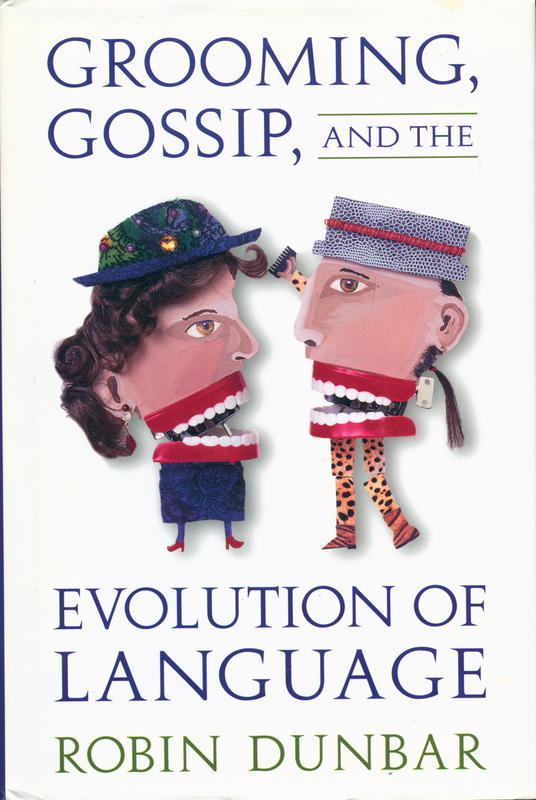
Grooming, gossip and the evolution of language / Robin Dunbar cover
Live
Grooming, gossip and the evolution of language / Robin Dunbar live spine
No live
Grooming, gossip and the evolution of language / Robin Dunbar spine Grooming, gossip and the evolution of language / Robin Dunbar live spine
Grooming, gossip and the evolution of language / Robin Dunbar cover
No live
TAGS
Curated Derived
Communication Connections Culture Evolution Human Evolution Humanity Language Life Sciences Linguistics Science Social Sciences
CONNECTIONS
No connections
State
on_shelf
True
position_updated_at
never
orientation
unknown
Details

Physical

binding_type
Hard Back
dimensions
210.00 (H) × 140.00 (W) × 19.00 (T) mm
spine_text
none captured
LOCATION HISTORY
G:W1:7 2 Current vertical
1 week, 3 days ago
1 week, 3 days ago
1 week, 5 days ago
Unknown location vertical
1 week, 6 days ago
Vernon snapshot
View live

Frozen copy of Vernon's record from the last sync. Fields tagged flow back into the Pulse record.

Last synced 2026-05-21 01:53 (4 days, 11 hours ago)

Identity

name→ title
Grooming, gossip and the evolution of language / Robin Dunbar
vernon_id
38676
accession_no→ accession_number
27659
vernon_slug
grooming-gossip-and-the-evolution-of-language-robin-dunbar

Drives Pulse state

curr_loc_status→ on_shelf
On Shelf
location_name
Zone W1 (Live bays)/Level 1/Phrontisterion/MONA
location_reason
On Shelf
isbn_issn→ isbn (when valid)
0674363345

Descriptive

production_date
1996
object_type
Books/Document genres/Information forms/Visual and Verbal Communication
object_status
Accessioned
brief_description
Apes and monkeys, humanity's closest kin, differ from other animals in the intensity of their social relationships. All their grooming is not so much about hygiene as it is about cementing bonds, making friends, and influencing fellow primates. But for early humans, grooming as a way to social success posed a problem: given their large social groups of 150 or so, our earliest ancestors would have had to spend almost half their time grooming one another - an impossible burden. What Dunbar suggests - and his research, whether in the realm of primatology or in that of gossip, confirms - is that humans developed language to serve the same purpose, but far more efficiently. It seems there is nothing idle about chatter, which holds together a diverse, dynamic group - whether of hunter-gatherers, soldiers, or workmates. Anthropologists have long assumed that language developed in relationships among males during activities such as hunting. Dunbar's original and extremely interesting studies suggest otherwise: that language in fact evolved in response to our need to keep up to date with friends and family. We needed conversation to stay in touch, and we still need it in ways that will not be satisfied by teleconferencing, e-mail, or any other communication technology. As Dunbar shows, the impersonal world of cyberspace will not fulfill our primordial need for face-to-face contact.

Subjects & people

authors→ author (initial fill only)
Robin Dunbar
tags→ tags
Science, Group identity, Social psychology, Psychology, Life sciences, Social sciences, Civilisation, Sociology, Communication, Culture, Evolution (Biology), Biology, Human evolution, Interpersonal relations, Human behaviour, Social evolution, Language and languages -- Origin
subject_people
subject_objects

Cover image

vernon_cover_image_id→ cover_image
44226

Raw Vernon JSON

click to inspect

The source payload behind the snapshot above.

Use ⌘F to search once expanded.
{7 keys}
"slug": "grooming-gossip-and-the-evolution-of-language-robin-dunbar"
"opacObjectId": "38676"
"opacCollection": {1 keys}
"opacCollectionId": "1"
"imagesCollection": {2 keys}
"images": [1 items]
"[0]": {5 keys}
"imageId": "44226"
"cssColors": [5 items]
"[0]": {9 keys}
"hex": "f5f5f5"
"hue": 0
"rank": 1
"presence": 73.41
"colorName": "whitesmoke"
"lightness": 96
"colorGroup": "white"
"saturation": 0
"formattedColorName": "white smoke"
"[1]": {9 keys}
"hex": "708090"
"hue": 210
"rank": 2
"presence": 11.75
"colorName": "slategray"
"lightness": 50
"colorGroup": "gray"
"saturation": 13
"formattedColorName": "slate gray"
"[2]": {9 keys}
"hex": "a52a2a"
"hue": 0
"rank": 3
"presence": 3.69
"colorName": "brown"
"lightness": 41
"colorGroup": "brown"
"saturation": 59
"formattedColorName": "brown"
"[3]": {9 keys}
"hex": "778899"
"hue": 210
"rank": 4
"presence": 5.52
"colorName": "lightslategray"
"lightness": 53
"colorGroup": "gray"
"saturation": 14
"formattedColorName": "light slate gray"
"[4]": {9 keys}
"hex": "bc8f8f"
"hue": 0
"rank": 5
"presence": 5.37
"colorName": "rosybrown"
"lightness": 65
"colorGroup": "brown"
"saturation": 25
"formattedColorName": "rosy brown"
"rawColors": [7 items]
"[0]": {6 keys}
"hex": "f7f7f5"
"hue": 60
"rank": 1
"presence": 73.41
"lightness": 96
"saturation": 11
"[1]": {6 keys}
"hex": "403d55"
"hue": 247
"rank": 2
"presence": 11.75
"lightness": 28
"saturation": 16
"[2]": {6 keys}
"hex": "a44558"
"hue": 348
"rank": 3
"presence": 3.69
"lightness": 45
"saturation": 40
"[3]": {6 keys}
"hex": "9e9ba9"
"hue": 252
"rank": 4
"presence": 5.52
"lightness": 63
"saturation": 7
"[4]": {6 keys}
"hex": "d4979b"
"hue": 356
"rank": 5
"presence": 5.37
"lightness": 71
"saturation": 41
"[5]": {6 keys}
"hex": "9c8b6b"
"hue": 39
"rank": 6
"presence": 0.26
"lightness": 51
"saturation": 19
"[6]": {6 keys}
"hex": "718c62"
"hue": 98
"rank": 7
"presence": 0.01
"lightness": 46
"saturation": 17
"imageLabels": [10 items]
"[0]": {5 keys}
"count": 15171
"score": 86.54
"status": "auto_verified"
"imageLabel": "Book"
"imageLabelId": 67
"[1]": {5 keys}
"count": 19411
"score": 81.23
"status": "auto_verified"
"imageLabel": "Font"
"imageLabelId": 12
"[2]": {5 keys}
"count": 11760
"score": 81.14
"status": "auto_verified"
"imageLabel": "Poster"
"imageLabelId": 21
"[3]": {5 keys}
"count": 19018
"score": 78.68
"status": "auto_verified"
"imageLabel": "Publication"
"imageLabelId": 23
"[4]": {5 keys}
"count": 450
"score": 74.93
"status": "auto_verified"
"imageLabel": "Hat"
"imageLabelId": 348
"[5]": {5 keys}
"count": 5351
"score": 74.54
"status": "auto_verified"
"imageLabel": "Advertising"
"imageLabelId": 71
"[6]": {5 keys}
"count": 913
"score": 68.87
"status": "auto_verified"
"imageLabel": "Happy"
"imageLabelId": 66
"[7]": {5 keys}
"count": 797
"score": 68.28
"status": "auto_verified"
"imageLabel": "Design"
"imageLabelId": 264
"[8]": {5 keys}
"count": 5931
"score": 65.12
"status": "auto_verified"
"imageLabel": "Illustration"
"imageLabelId": 25
"[9]": {5 keys}
"count": 12694
"score": 60.22
"status": "auto_verified"
"imageLabel": "Book cover"
"imageLabelId": 90
"imageDerivatives": [6 items]
"[0]": {4 keys}
"url": "https://browser.mona.net.au/records/images/large/29009/c5dbefa9dacedddf75e4c9844e37593a66cbe011.jpg"
"width": "536"
"height": "800"
"identifier": "LARGE"
"[1]": {4 keys}
"url": "https://browser.mona.net.au/records/images/medium/29009/c5dbefa9dacedddf75e4c9844e37593a66cbe011.jpg"
"width": "268"
"height": "400"
"identifier": "MEDIUM"
"[2]": {4 keys}
"url": "https://browser.mona.net.au/records/images/nano/29009/c5dbefa9dacedddf75e4c9844e37593a66cbe011.jpg"
"width": "23"
"height": "35"
"identifier": "NANO"
"[3]": {4 keys}
"url": "https://browser.mona.net.au/records/images/small/29009/c5dbefa9dacedddf75e4c9844e37593a66cbe011.jpg"
"width": "100"
"height": "150"
"identifier": "SMALL"
"[4]": {4 keys}
"url": "https://browser.mona.net.au/records/images/tiny/29009/c5dbefa9dacedddf75e4c9844e37593a66cbe011.jpg"
"width": "50"
"height": "75"
"identifier": "TINY"
"[5]": {4 keys}
"url": "https://browser.mona.net.au/records/images/xlarge/29009/c5dbefa9dacedddf75e4c9844e37593a66cbe011.jpg"
"width": "804"
"height": "1200"
"identifier": "XLARGE"
"totalImages": 1
"objectSearchScore": 0.3118719
"opacObjectFieldSets": [40 items]
"[0]": {2 keys}
"identifier": "accession_no"
"opacObjectFields": [1 items]
"[0]": {1 keys}
"value": "27659"
"[1]": {2 keys}
"identifier": "name"
"opacObjectFields": [1 items]
"[0]": {2 keys}
"value": "Grooming, gossip and the evolution of language / Robin Dunbar"
"opacObjectFieldAttributes": [1 items]
"[0]": {2 keys}
"key": "title"
"value": "Grooming, gossip and the evolution of language / Robin Dunbar"
"[2]": {2 keys}
"identifier": "other_name"
"opacObjectFields": [1 items]
"[0]": {1 keys}
"value": ""
"[3]": {2 keys}
"identifier": "artist_last_first"
"opacObjectFields": [1 items]
"[0]": {1 keys}
"value": "Dunbar, Robin"
"[4]": {2 keys}
"identifier": "prod_pri_date"
"opacObjectFields": [1 items]
"[0]": {2 keys}
"value": "1996"
"opacObjectFieldAttributes": [2 items]
"[0]": {2 keys}
"key": "earliest_date"
"value": "1996-01-01Z"
"[1]": {2 keys}
"key": "latest_date"
"value": "1996-12-31Z"
"[5]": {2 keys}
"identifier": "prod_pri_date_notes"
"opacObjectFields": [1 items]
"[0]": {1 keys}
"value": ""
"[6]": {2 keys}
"identifier": "edition"
"opacObjectFields": [1 items]
"[0]": {1 keys}
"value": ""
"[7]": {2 keys}
"identifier": "brief_desc"
"opacObjectFields": [1 items]
"[0]": {1 keys}
"value": "Apes and monkeys, humanity's closest kin, differ from other animals in the intensity of their social relationships. All their grooming is not so much about hygiene as it is about cementing bonds, making friends, and influencing fellow primates. But for early humans, grooming as a way to social success posed a problem: given their large social groups of 150 or so, our earliest ancestors would have had to spend almost half their time grooming one another - an impossible burden. What Dunbar suggests - and his research, whether in the realm of primatology or in that of gossip, confirms - is that humans developed language to serve the same purpose, but far more efficiently. It seems there is nothing idle about chatter, which holds together a diverse, dynamic group - whether of hunter-gatherers, soldiers, or workmates. Anthropologists have long assumed that language developed in relationships among males during activities such as hunting. Dunbar's original and extremely interesting studies suggest otherwise: that language in fact evolved in response to our need to keep up to date with friends and family. We needed conversation to stay in touch, and we still need it in ways that will not be satisfied by teleconferencing, e-mail, or any other communication technology. As Dunbar shows, the impersonal world of cyberspace will not fulfill our primordial need for face-to-face contact."
"[8]": {2 keys}
"identifier": "measure_desc"
"opacObjectFields": [1 items]
"[0]": {1 keys}
"value": ""
"[9]": {2 keys}
"identifier": "credit_line"
"opacObjectFields": [1 items]
"[0]": {1 keys}
"value": ""
"[10]": {2 keys}
"identifier": "curr_loc_status"
"opacObjectFields": [1 items]
"[0]": {2 keys}
"value": "On Shelf"
"opacObjectFieldAttributes": [1 items]
"[0]": {2 keys}
"key": "search"
"value": "curr_loc_status:"On Shelf""
"[11]": {2 keys}
"identifier": "ob_status"
"opacObjectFields": [1 items]
"[0]": {1 keys}
"value": "Accessioned"
"[12]": {2 keys}
"identifier": "lender"
"opacObjectFields": [1 items]
"[0]": {1 keys}
"value": ""
"[13]": {2 keys}
"identifier": "copyright_owner"
"opacObjectFields": [1 items]
"[0]": {1 keys}
"value": ""
"[14]": {2 keys}
"identifier": "copyright_type"
"opacObjectFields": [1 items]
"[0]": {1 keys}
"value": ""
"[15]": {2 keys}
"identifier": "copyright_start"
"opacObjectFields": [0 items]
"[16]": {2 keys}
"identifier": "copyright_expiry"
"opacObjectFields": [0 items]
"[17]": {2 keys}
"identifier": "copyright_notes"
"opacObjectFields": [1 items]
"[0]": {1 keys}
"value": ""
"[18]": {2 keys}
"identifier": "curr_loc"
"opacObjectFields": [1 items]
"[0]": {1 keys}
"value": "Zone W1 (Live bays)/Level 1/Phrontisterion/MONA"
"[19]": {2 keys}
"identifier": "object_type"
"opacObjectFields": [1 items]
"[0]": {2 keys}
"value": "Books/Document genres/Information forms/Visual and Verbal Communication"
"opacObjectFieldAttributes": [1 items]
"[0]": {2 keys}
"key": "search"
"value": "object_type:"Books/Document genres/Information forms/Visual and Verbal Communication""
"[20]": {2 keys}
"identifier": "collection"
"opacObjectFields": [1 items]
"[0]": {2 keys}
"value": "Main Collection/Library"
"opacObjectFieldAttributes": [1 items]
"[0]": {2 keys}
"key": "search"
"value": "collection:"Main Collection/Library""
"[21]": {2 keys}
"identifier": "prod_pri_place"
"opacObjectFields": [1 items]
"[0]": {1 keys}
"value": "Cambridge/Massachusetts/United States of America"
"[22]": {2 keys}
"identifier": "prod_pri_publisher"
"opacObjectFields": [1 items]
"[0]": {1 keys}
"value": "Harvard University Press"
"[23]": {2 keys}
"identifier": "physical_notes"
"opacObjectFields": [1 items]
"[0]": {1 keys}
"value": ""
"[24]": {2 keys}
"identifier": "language"
"opacObjectFields": [1 items]
"[0]": {1 keys}
"value": "English"
"[25]": {2 keys}
"identifier": "isbn_issn"
"opacObjectFields": [1 items]
"[0]": {1 keys}
"value": "0674363345"
"[26]": {2 keys}
"identifier": "user_sym_1"
"opacObjectFields": [1 items]
"[0]": {1 keys}
"value": "401 DUN"
"[27]": {2 keys}
"identifier": "usual_loc_being"
"opacObjectFields": [1 items]
"[0]": {1 keys}
"value": "Zone W1 (Live bays)/Level 1/Phrontisterion/MONA"
"[28]": {2 keys}
"identifier": "subject_class"
"opacObjectFields": [6 items]
"[0]": {2 keys}
"value": "Group identity/Social psychology/Psychology"
"opacObjectFieldAttributes": [1 items]
"[0]": {2 keys}
"key": "search"
"value": "subject_class:"Group identity/Social psychology/Psychology""
"[1]": {2 keys}
"value": "Human behaviour/Social sciences/Civilisation"
"opacObjectFieldAttributes": [1 items]
"[0]": {2 keys}
"key": "search"
"value": "subject_class:"Human behaviour/Social sciences/Civilisation""
"[2]": {2 keys}
"value": "Human evolution/Evolution (Biology)/Biology/Life sciences/Science"
"opacObjectFieldAttributes": [1 items]
"[0]": {2 keys}
"key": "search"
"value": "subject_class:"Human evolution/Evolution (Biology)/Biology/Life sciences/Science""
"[3]": {2 keys}
"value": "Interpersonal relations/Social psychology/Psychology"
"opacObjectFieldAttributes": [1 items]
"[0]": {2 keys}
"key": "search"
"value": "subject_class:"Interpersonal relations/Social psychology/Psychology""
"[4]": {2 keys}
"value": "Language and languages -- Origin/Communication/Sociology/Social sciences/Civilisation"
"opacObjectFieldAttributes": [1 items]
"[0]": {2 keys}
"key": "search"
"value": "subject_class:"Language and languages -- Origin/Communication/Sociology/Social sciences/Civilisation""
"[5]": {2 keys}
"value": "Social evolution/Culture"
"opacObjectFieldAttributes": [1 items]
"[0]": {2 keys}
"key": "search"
"value": "subject_class:"Social evolution/Culture""
"[29]": {2 keys}
"identifier": "subject_date"
"opacObjectFields": [0 items]
"[30]": {2 keys}
"identifier": "subject_event"
"opacObjectFields": [1 items]
"[0]": {1 keys}
"value": ""
"[31]": {2 keys}
"identifier": "subject_period"
"opacObjectFields": [1 items]
"[0]": {1 keys}
"value": ""
"[32]": {2 keys}
"identifier": "subject_object"
"opacObjectFields": [1 items]
"[0]": {1 keys}
"value": ""
"[33]": {2 keys}
"identifier": "subject_person"
"opacObjectFields": [1 items]
"[0]": {1 keys}
"value": ""
"[34]": {2 keys}
"identifier": "subject_place"
"opacObjectFields": [1 items]
"[0]": {1 keys}
"value": ""
"[35]": {2 keys}
"identifier": "assoc_person"
"opacObjectFields": [1 items]
"[0]": {1 keys}
"value": ""
"[36]": {2 keys}
"identifier": "assoc_place"
"opacObjectFields": [1 items]
"[0]": {1 keys}
"value": ""
"[37]": {2 keys}
"identifier": "assoc_event"
"opacObjectFields": [1 items]
"[0]": {1 keys}
"value": ""
"[38]": {2 keys}
"identifier": "assoc_object"
"opacObjectFields": [1 items]
"[0]": {1 keys}
"value": ""
"[39]": {2 keys}
"identifier": "user_sym_9"
"opacObjectFields": [1 items]
"[0]": {1 keys}
"value": ""
"relationshipsCollection": {2 keys}
"relationships": [1 items]
"[0]": {4 keys}
"relatedRecords": [1 items]
"[0]": {3 keys}
"slug": "robin-dunbar"
"title": "Robin Dunbar"
"relatedRecordId": "19141"
"relationshipId": "object_prod_pri_person"
"relatedRecordType": "person"
"totalRelatedRecords": 1
"totalRelationships": 1
