Art of the modern age : philosophy of art from Kant to Heidegger / Jean-Marie Schaeffer ; translaed by Steven Rendall; foreword by Arthur C. Danto
[No description found]
CONNECTIONS
No connections
LOCATION HISTORY
Mezzanine, S3 bay 27, shelf 4
Current
(vertical)
May 15, 2026 15:37
FULL RECORD
Accession Number: 3069
Site: Vernon O Content
Collection: N/A
Location: N/A
Binding Type: Hard Back
Book Images
Hover to see live images
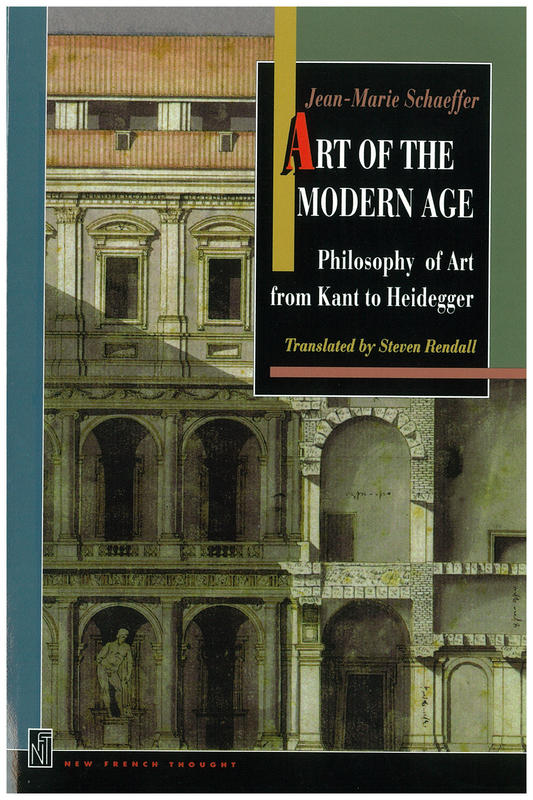
No live
Vernon Fields
View in Vernon Browser| vernon_accession | 3069 |
| vernon_id | 6888 |
| vernon_slug | art-of-the-modern-age-philosophy-of-art-from-kant-to-heidegger-jean-marie-schaeffer-translaed-by-steven-rendall-foreword-by-arthur-c-danto |
| vernon_authors | Jean-Marie Schaeffer, Steven Rendall, Arthur C. Danto |
| vernon_tags | Art, Arts, Art, Modern -- 20th century, Philosophy, Art -- Philosophy, Modernism (Art), Aesthetic movement (Art), Rhetoric, Authorship, Aesthetics, Art criticism, Criticism, Art critics, Critics, Art appreciation, Avant-garde (Aesthetics) |
| vernon_production_date | 2000 |
| vernon_brief_description | A trenchant critique of the philosophy of art as it developed from the eighteenth century to the early twentieth century, combined with a carefully reasoned plea for a new and more flexible approach to art. Jean-Marie Schaeffer, one of France's leading aestheticians, explores the writings of Kant, Schlegel, Novalis, Hegel, Schopenhauer, Nietzsche, and Heidegger to show that these diverse thinkers shared a common approach to art, which he calls the "speculative theory." According to this theory, art offers a special kind of intuitive, quasi-mystical knowledge, radically different from the rational knowledge acquired by science. This view encouraged theorists to consider artistic geniuses the high-priests of humanity, creators of works that reveal the invisible essence of the world. Philosophers came to regard inexpressibility as the aim of art, refused to consider second-tier creations genuine art, and helped to create conditions in which the genius was expected to shock, puzzle, and mystify the public.Schaeffer shows that this speculative theory helped give birth to romanticism, modernism, and the avant-garde, and paved the way for an unfortunate divorce between art and enjoyment, between "high art" and popular art, and between artists and their public. Rejecting the speculative approach, Schaeffer concludes by defending a more tolerant theory of art that gives pleasure its due, includes popular art, tolerates less successful works, and accounts for personal tastes. |
| vernon_object_type | Books/Document genres/Information forms/Visual and Verbal Communication |
| vernon_locations | Stored |
| vernon_ob_status | Accessioned |
| vernon_isbn_issn | 9780691144368 |
| vernon_subject_people | Immanuel Kant (German, b.1724, d.1804), Georg Hegel (German, b.1770, d.1831), Friedrich Nietzsche (German, b.1844, d.1900), Martin Heidegger (German, b.1889, d.1976) |
| vernon_subject_objects | — |
| vernon_subject_classes | — |
| vernon_last_sync_timestamp | 2026-02-19 11:18 |
| vernon_cover_image_id | 23517 |